Author: C.J. Collier

  • Why Perl Lost the Cloud Era, and How Native gRPC, Protobuf, and GenAI SDKs Can Bring It Back

    Disclaimer: The opinions stated here are my own, not those of my employer.

    Every so often, someone asks why Perl—once the undisputed duct tape of the Internet—faded from mainstream greenfield software development. Was there a single cultural flashpoint that “canceled” Perl? Was it the fifteen-year wait for Perl 6? Or did Damian Conway’s Perl Best Practices, Perl::Critic, and CPAN’s Kwalitee metrics simply arrive too late?

    Having spent time recently building a modern Protocol Buffers and gRPC cloud client stack for Perl, I’ve come to a simple conclusion: languages don’t fade solely because of syntax debates. They decline when the friction of talking to the current generation of infrastructure outweighs the language’s natural strengths.

    Here is a look back at why Perl lost momentum during the 2000s enterprise shift—and why the GenAI and gRPC era offers an unexpected opening for a modern Perl resurgence.


    1. What Actually Drove Perl’s Decline?

    Perl wasn’t sidelined by a single societal scandal. Rather, several technical, historical, and organizational forces converged between 2000 and 2012:

    TIMTOWTDI vs. Readability at Scale

    Designed by Larry Wall—a linguist by training—Perl embraced natural-language expressiveness under the motto “There’s More Than One Way To Do It” (TIMTOWTDI). Context sensitivity, topicalizers ($_), and compact regex idioms made Perl extraordinarily fast for an individual developer or sysadmin to write. Seat a hundred engineers in a shared codebase without shared guardrails, however, and TIMTOWTDI produces divergent dialects.

    As software teams scaled in the late 1990s and 2000s, engineering leadership increasingly favored Python’s counter-philosophy (“There should be one—and preferably only one—obvious way to do it”), prioritizing uniform, easily reviewable code over expressive flexibility. Tellingly, the public Google Style Guides repository maintains official prose guides for C++, C#, Go, Java, JavaScript, Python, Shell, and TypeScript—while omitting Perl altogether, leaving open-source Google Perl projects to codify standards directly in executable .perlcriticrc and .perltidyrc configurations alongside core perlstyle and Perl Best Practices.

    The Perl 6 (Raku) Waiting Game & Ecosystem Shifts

    If one historical event hurt Perl’s momentum above all else, it was the Perl 6 transition. Announced in 2000 as an ambitious, backward-incompatible redesign, Perl 6 took 15 years to reach a stable specification (ultimately renaming to Raku in 2019 as a distinct sister language). During that 2000–2015 window, much of the industry assumed Perl 5 was in maintenance mode—even as Perl 5 underwent a major renaissance between 2007 and 2012 (Modern Perl, Perl 5.10+, Moose, Moo, PSGI/Plack, and cpanminus).

    Meanwhile, Perl’s traditional strongholds migrated elsewhere: CGI.pm and mod_perl gave way to PHP, Ruby on Rails, and Django; cloud and DevOps tooling (Puppet, Chef, Ansible, Docker, Kubernetes, Terraform) coalesced around Ruby, Python, and Go; and scientific computing shifted from Perl’s 1990s bioinformatics dominance to Python’s C-extension ecosystem (NumPy, SciPy, Pandas, PyTorch). Even the 2020 debates over a proposed jump to “Perl 7″—which never came to fruition, ultimately giving way to the Perl Steering Council and steady incremental modernization via use v5.36 and use v5.40—happened long after that 2000s market shift.

    Why Perl Best Practices, Perl::Critic, and Kwalitee Didn’t Reverse the Trend Alone

    Damian Conway’s Perl Best Practices (2005), static analysis via Perl::Critic (built on PPI), formatting via Perl::Tidy, and CPAN’s Kwalitee metrics (Module::CPANTS::Analyse) solved many of the readability complaints associated with 1990s Perl. Enforce strict Perl::Critic policies and modern conventions, and Perl code becomes remarkably clear and intentional. Yet four structural factors kept those tools from reversing the broader industry trend:

    • Opt-in discipline vs. language defaults: Unlike Python’s indentation grammar or Go’s gofmt, clean Perl relies on opt-in team toolchain discipline—and two “Modern Perl” teams can still choose different object dialects (blessed hashes, Moose, Moo, or Perl 5.38+ Corinna class blocks).
    • Static analysis limits (“Only perl can parse Perl”): Because BEGIN blocks, prototypes, and symbol-table manipulation make Perl 5 undecidable to parse statically in full generality, PPI excels at lint policies but cannot easily power the deep static type checking and automated million-line AST refactorings that enterprise monorepos rely on.
    • What Kwalitee actually measures: Coined as a tongue-in-cheek pun on “Quality” (“it looks like quality, it sounds like quality, but it’s not quite quality”), Kwalitee measures CPAN distribution hygiene—metadata, licenses, POD, use strict, and test suites—making CPAN extraordinarily reliable, without addressing application-scale type safety.
    • The 2005–2011 timing gap: By the time Modern Perl matured, major tech companies had already locked in build systems, hermetic toolchains, and RPC code generators for Python and Java, leaving little appetite to fund parallel infrastructure for a second dynamic scripting language.

    2. The Real Blocker Today: The Protobuf & gRPC Chasm

    If you write Perl 5.36–5.40+ today—with native subroutine signatures, try/catch, builtin booleans, Moo or Corinna class blocks, and strict Perl::Critic gates—the language itself is clean, fast, and expressive.

    The real wall a modern Perl engineer hits isn’t syntax. It’s infrastructure integration.

    Over the past decade, cloud databases and AI services standardized on Protocol Buffers (Proto3 / Edition 2024) and gRPC over HTTP/2, using automated generators like GAPIC to ship official client libraries for Python, Go, Java, TypeScript, C#, Ruby, and PHP. Perl was left off that list. Even major commercial libraries such as the Google Ads API Perl Client Library had to build custom HTTP/1.1 REST/JSON wrappers because Perl lacked an official upb Protobuf runtime and native gRPC stack.

    When calling Cloud Spanner or an LLM requires hand-rolling OAuth2 token flows, REST wrappers, and JSON payload builders for every service, Perl loses its greatest superpower: getting complex things done fast.


    3. Closing the Gap: A Modular Cloud & AI Stack for Perl

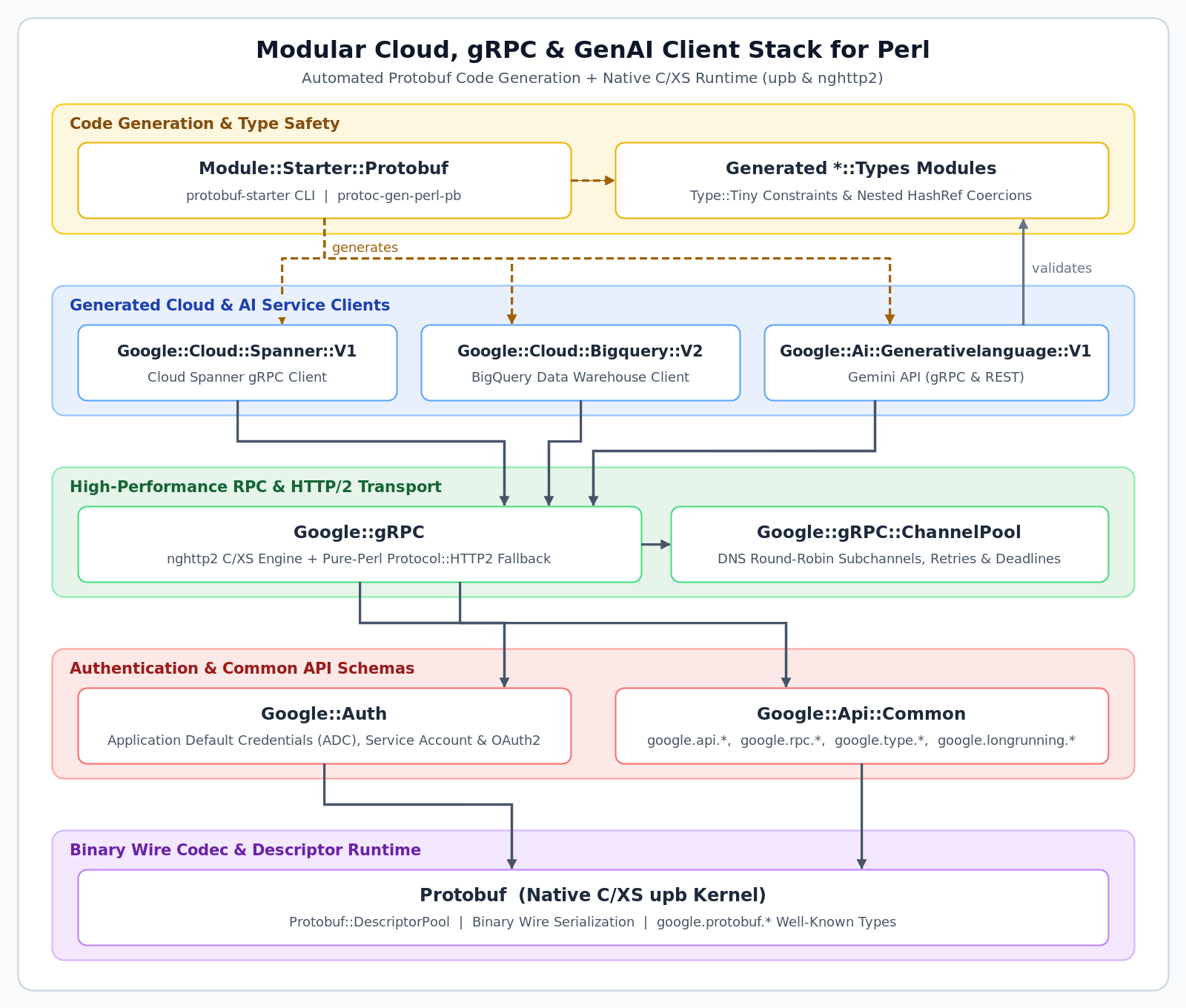
    To test whether modern API ergonomics can revitalize Perl for cloud and AI engineering, I’ve been building an open-source modular stack (published on CPAN and GitHub) that brings first-class Protocol Buffers, gRPC, DBI drivers, and automated client generation to Perl:

    Architecture diagram of the modular Perl Cloud, gRPC, and GenAI client stack
    Figure 1: Open-source Protocol Buffers, gRPC, and automated client-generation stack for Perl.

    With this stack in place, querying Cloud Spanner over native gRPC in Perl requires zero hand-rolled REST boilerplate:

    use strict;
    use warnings;
    use Google::Cloud::Spanner::V1;
    use Google::Auth;
    
    # 1. Initialize Application Default Credentials (ADC)
    my $auth = Google::Auth->default();
    
    # 2. Initialize Spanner Client over gRPC transport
    my $spanner = Google::Cloud::Spanner::V1->new(
        credentials => $auth,
    );
    
    # 3. Execute SQL Query
    my $result = $spanner->execute_sql(
        database => 'projects/my-proj/instances/my-inst/databases/my-db',
        sql      => 'SELECT 1 AS alive',
    );

    And calling Gemini via Google::Ai::Generativelanguage::V1 with automatic nested hashref-to-Protobuf coercion feels just as ergonomic as Python or Go:

    use strict;
    use warnings;
    use Google::Ai::Generativelanguage::V1;
    use Google::Auth;
    
    my $gemini = Google::Ai::Generativelanguage::V1->new(
        credentials => Google::Auth->default(),
    );
    
    my $response = $gemini->generate_content(
        model    => 'models/gemini-2.5-pro',
        contents => [
            {
                role  => 'user',
                parts => [ { text => 'Summarize this stack trace in three bullets.' } ],
            },
        ],
    );

    4. What This Means for Debian Developers and Systems Administrators

    Nowhere is this gap—and the opportunity to close it—more tangible than on Debian.

    While greenfield web startups may have moved on from Perl, Debian remains one of the largest, healthiest Modern Perl ecosystems on the planet. Core project tooling—dpkg-dev (Dpkg::*), debhelper, lintian, devscripts (uscan, dch, debuild), debconf, and po4a—is written in Perl, backed by more than 4,000 lib*-perl packages maintained by the Debian Perl Group (pkg-perl). And Debian 13 (trixie) ships Perl v5.40.1 right in base, giving every Debian machine native subroutine signatures, lexical try/catch, and builtin booleans out of the box.

    Yet until now, a Debian developer or systems administrator who wanted to interface with Google Cloud from an existing Perl tool had to either install the multi-hundred-megabyte Python-bundled google-cloud-cli (gcloud / bq) just to shell out and scrape stdout, or rewrite working Perl automation into another language.

    Having a native Perl gRPC, Protobuf, and Auth stack—and pairing it with native Debian packaging—changes day-to-day life on Debian in four concrete ways:

    1. Keyless IAM Auth on Debian Cloud VMs

    When running official Debian Cloud images on Compute Engine, GKE (with Workload Identity), or Cloud Run, Google::Auth->default() speaks directly to the local GCE metadata server (metadata.google.internal) to fetch and cache short-lived OAuth2 tokens for the attached IAM service account. Sysadmins no longer need to deploy long-lived service-account JSON keys into /etc/ or shell out to gcloud auth print-access-token inside cron jobs and systemd units.

    2. Moving Beyond local::lib (and venv) to Native pkg-perl Packages

    Right now, before these distributions land in the Debian archive, installing them cleanly from CPAN without polluting /usr requires local::lib (e.g., cpanm --local-lib=~/perl5)—which is the exact Perl counterpart to maintaining an isolated Python venv on Debian 12 (bookworm) and Debian 13 (trixie) under PEP 668 (EXTERNALLY-MANAGED). Even under local::lib, keeping cloud RPC calls in-process avoids pulling in the ~500 MB google-cloud-cli bundle or splitting an existing Perl daemon across two runtimes.

    The real goal on Debian, however, is eliminating per-user overlay trees altogether via native .deb packages maintained with the Debian Perl Group (pkg-perl)—so administrators can install libgoogle-auth-perl, libgoogle-grpc-perl, and service clients straight from apt with dpkg verification, sbuild reproducibility, and autopkgtest-pkg-perl coverage.

    3. Alignment with Debian’s Packaged Libraries & Policy

    Most of the runtime and build prerequisites already ship in Debian main (verified on trixie), making native packaging straightforward:

    • libssl-dev backs Google::Auth‘s XS crypto bindings, and libnghttp2-dev provides the shared system C library for Google::gRPC‘s C/XS HTTP/2 engine—while libprotocol-http2-perl (already in Debian main) powers the 100% pure-Perl HTTP/2 fallback.
    • libmoo-perl, libtype-tiny-perl, libfuture-perl, liblog-any-perl, libperl-critic-perl, and perltidy are all available via apt today.
    • Draft placeholder before publishing: Add links to the WNPP ITP bugs and Salsa / pkg-perl packaging repositories (including coordinating upb packaging details under Debian Policy §4.13 for Protobuf).

    4. Practical Workflows for DDs and Sysadmins

    On a Debian 13 (trixie) host running Perl v5.40, streaming structured fleet telemetry to BigQuery or triaging failed sbuild / autopkgtest logs with Gemini fits naturally into idiomatic modern Perl—using native v5.40 signatures and try/catch without a single shell-out:

    #!/usr/bin/perl
    use v5.40;
    use Google::Auth;
    use Google::Cloud::Bigquery::V2;
    use Sys::Hostname qw(hostname);
    
    sub record_package_audit ($pkg, $version, $status) {
        my $bq = Google::Cloud::Bigquery::V2->new(
            credentials => Google::Auth->default(), # GCE metadata server / ADC
        );
    
        try {
            $bq->insert_all(
                project_id => 'my-debian-fleet',
                dataset_id => 'ops_telemetry',
                table_id   => 'dpkg_audits',
                rows       => [
                    {
                        json => {
                            host    => hostname(),
                            package => $pkg,
                            version => $version,
                            status  => $status,
                        },
                    },
                ],
            );
        }
        catch ($err) {
            warn "BigQuery telemetry insert failed: $errn";
        }
    }

    Whether it is archiving buildd and QA metrics into BigQuery, storing distributed coordination state in Cloud Spanner, or summarizing 10,000-line FTBFS (“Fails To Build From Source”) logs via Google::Ai::Generativelanguage::V1, Debian maintainers and sysadmins can keep their automation in a single, auditable, dpkg-managed language rather than splitting glue code across Perl, bash, jq, and Python virtualenvs.


    5. Why the GenAI Era Plays to Perl’s Strengths—and the Headwinds Ahead

    In classical machine learning, Python’s lead was anchored by in-process C/C++ tensor libraries (NumPy, PyTorch). In the LLM and AI Agent era, however, the heavy matrix math happens remotely behind an RPC endpoint. What happens on the client side?

    • Ingesting gigabytes of messy, compressed distributed-system event logs and diagnostic traces.
    • Running high-speed regular expressions and text distillation pipelines.
    • Validating structured outputs and coercing hashrefs into strict request schemas via Type::Tiny.
    • Orchestrating Unix CLI tools, SQL queries, and concurrent gRPC calls.

    That is Perl’s historic wheelhouse. Just as importantly, thousands of enterprises and veteran SREs still maintain battle-tested brownfield Perl systems; drop-in CPAN clients for Spanner, BigQuery, and Gemini let teams modernize those systems in place rather than forcing a costly rewrite into Python or Go simply to call a gRPC API.

    Two realistic headwinds remain:

    1. The AI code-generation feedback loop: Modern LLM coding assistants are trained overwhelmingly on recent Python, TypeScript, Go, and Rust code, and can default to dated 2000s Perl idioms if left unguided. Embedding automated 00_critic.t, 00_tidy.t, and 00_pod.t author tests—backed by concrete .perlcriticrc and .perltidyrc rulesets—directly into generated Module::Starter::Protobuf skeletons turns out to be an ideal counterweight, acting as an automated guardrail that keeps AI-assisted Perl clean and idiomatic.
    2. The education and hiring pipeline: Universities and bootcamps standardized on Python and JavaScript over the past 15 years, so greenfield staffing decisions will continue to favor larger hiring pools.

    Will ergonomic gRPC and GenAI SDKs make universities teach Perl 101 again? Unlikely. Will they make Perl a high-leverage powerhouse again for engineers and organizations who value its text-processing and Unix orchestration strengths? Without question—because in an API-driven world, a language is only as alive as the services it can talk to natively.

  • Finding: Promoting SeaBIOS Cloud Images to UEFI Secure Boot (Proxmox)

    Discovery

    Legacy cloud templates often lack the partitioning and bootloader
    binaries required for UEFI Secure Boot. Attempting to switch such a VM
    to OVMF in Proxmox results in “not a bootable disk.” We discovered that
    a surgical promotion is possible by manipulating the block device and
    EFI variables from the hypervisor.

    The Problem

    1. Protective MBR Flags: Legacy installers often set
      the pmbr_boot flag on the GPT’s protective MBR. Strict UEFI
      implementations (OVMF) will ignore the GPT if this flag is present.
    2. Missing ESP: Cloud images often lack a FAT32 EFI
      System Partition (ESP).
    3. Variable Store: A fresh Proxmox
      efidisk0 is empty and lacks both the trust certificates
      (PK/KEK/db) and the BootOrder entries required for an automated
      boot.

    The “Promotion” Rule

    To upgrade a SeaBIOS VM to Secure Boot without a full OS reinstall:
    1. Surgical Partitioning: Map the disk on the host and
    add a FAT32 partition (Type EF00). Clear the
    pmbr_boot flag from the MBR. 2. Binary
    Preparation:
    Boot the VM in SeaBIOS mode to install
    shim and grub-efi packages. Use
    grub2-mkconfig to populate the new ESP. 3. Trust
    Injection:
    Use the virt-fw-vars utility on the
    hypervisor to programmatically enroll the Red Hat/Microsoft CA keys and
    any custom certificates (e.g., FreeIPA CA) into the VM’s
    efidisk. 4. Boot Pinning: Explicitly set
    the UEFI BootOrder to point to the shimx64.efi
    path via virt-fw-vars --append-boot-filepath.

    Solution (Example Command
    Sequence)

    On the Proxmox Host (root):

    # Map and Clean MBR
    DEV=$(rbd map pool/disk)
    parted -s $DEV disk_set pmbr_boot off
    
    # Inject Trust and Boot Path (VM must be stopped)
    virt-fw-vars --inplace /dev/rbd/mapped_efidisk \
      --enroll-redhat \
      --add-db <GUID> /path/to/ipa-ca.crt \
      --append-boot-filepath '\EFI\centos\shimx64.efi' \
      --sb

    This workflow enables high-integrity Secure Boot environments using
    existing SeaBIOS infrastructure templates.

  • The WWW::Mechanize::Chrome Saga: A Comprehensive Narrative of PR #104

    The
    WWW::Mechanize::Chrome Saga: A Comprehensive Narrative of PR #104

    This document synthesizes the extensive work performed from March
    13th to March 20th, 2026, to harden, stabilize, and refactor the
    WWW::Mechanize::Chrome library and its test suite. This
    effort involved deep dives into asynchronous programming,
    platform-specific bug hunting, and strategic architectural
    decisions.


    Part I:
    The Quest for Cross-Platform Stability (March 13 – 16)

    The initial phase of work focused on achieving a “green” test suite
    across a variety of Linux distributions and preparing for a new release.
    This involved significant hardening of the library to account for
    different browser versions, OS-level security restrictions, and
    filesystem differences.

    Key Milestones &
    Engineering Decisions:

    • Fedora & RHEL-family Success: A major effort
      was undertaken to achieve a 100% pass rate on modern Fedora 43 and
      CentOS Stream 10. This required several key engineering decisions to
      handle modern browser behavior:

      • Decision: Implement Asynchronous DOM Serialization
        Fallback.
        Synchronous fallbacks in an async context are
        dangerous. To prevent Resource was not cached errors during
        saveResources, we implemented a fully asynchronous fallback
        in _saveResourceTree. By chaining
        _cached_document with DOM.getOuterHTML
        messages, we can reconstruct document content without blocking the event
        loop, even if Chromium has evicted the resource from its cache. This
        also proved resilient against Fedora’s security policies, which often
        block file:// access.
      • Decision: Truncate Filenames for Cross-Platform
        Safety.
        To avoid File name too long errors,
        especially on Windows where the MAX_PATH limit is 260
        characters, filenameFromUrl was hardened. The filename
        truncation was reduced to a more conservative 150
        characters
        , leaving ample headroom for deeply nested CI
        temporary directories. Logic was also added to preserve file extensions
        during truncation and to sanitize backslashes from URI paths.
      • Decision: Expand Browser Discovery Paths. To
        support RHEL-based systems out-of-the-box, the
        default_executable_names was expanded to include
        headless_shell and search paths were updated to include
        /usr/lib64/chromium-browser/.
      • Decision: Mitigate Race Conditions with Stabilization Waits
        and Resilient Fetching.
        On fast systems,
        DOM.documentUpdated events could invalidate
        nodeIds immediately after navigation, causing XPath queries
        to fail with “Could not find node with given id”. A small stabilization
        sleep(0.25s) was added after page loads to ensure the DOM
        is settled. Furthermore, the asynchronous DOM fetching loop was hardened
        to gracefully handle these errors by catching protocol errors and
        returning an empty string for any node that was invalidated during
        serialization, ensuring the overall process could complete.
    • Windows Hardening:
      • Decision: Adopt Platform-Aware Watchdogs. The test
        suite’s reliance on ualarm was a blocker for Windows, where
        it is not implemented. The t::helper::set_watchdog function
        was refactored to use standard alarm() (seconds) on Windows
        and ualarm (microseconds) on Unix-like systems, enabling
        consistent test-level timeout enforcement.
    • Version 0.77 Release:
      • Decision: Adopt SOP for Version Synchronization.
        The project maintains duplicate version strings across 24+ files. A
        Standard Operating Procedure was adopted to use a batch-replacement tool
        to update all sub-modules in lib/ and to always run
        make clean and perl Makefile.PL to ensure
        META.json and META.yml reflect the new
        version. After achieving stability on Linux, the project version was
        bumped to 0.77.
    • Infrastructure & Strategic Work:
      • The ad2 Windows Server 2025 instance was restored and
        optimized, with Active Directory demoted and disk I/O performance
        improved.
      • A strategic proposal for the Heterogeneous Directory
        Replication Protocol (HDRP)
        was drafted and published.

    Part II: The
    Great Async Refactor (March 17 – 18)

    Despite success on Linux, tests on the slow ad2 Windows
    host were still plagued by intermittent, indefinite hangs. This
    triggered a fundamental architectural shift to move the library’s core
    from a mix of synchronous and asynchronous code to a fully non-blocking
    internal API.

    Key Milestones &
    Engineering Decisions:

    • Decision: Expose a _future API.
      Instead of hardcoding timeouts in the library, the core strategy was to
      refactor all blocking methods (xpath, field,
      get, etc.) into thin wrappers around new non-blocking
      ..._future counterparts. This moved timeout management to
      the test harness, allowing for flexible and explicit handling of
      stalls.

      # Example library implementation
      sub xpath($self, $query, %options) {
          return $self->xpath_future($query, %options)->get;
      }
      
      sub xpath_future($self, $query, %options) {
          # Async implementation using $self->target->send_message(...)
      }
    • Decision: Centralize Test Hardening in a Helper.
      A dedicated test library, t/lib/t/helper.pm, was created to
      contain all stabilization logic. “Safe” wrappers (safe_get,
      safe_xpath) were implemented there, using
      Future->wait_any to race asynchronous operations against
      a timeout, preventing tests from hanging.

      # Example test helper implementation
      sub safe_xpath {
          my ($mech, $query, %options) = @_;
          my $timeout = delete $options{timeout} || 5;
          my $call_f = $mech->xpath_future($query, %options);
          my $timeout_f = $mech->sleep_future($timeout)->then(sub { Future->fail("Timeout") });
          return Future->wait_any($call_f, $timeout_f)->get;
      }
    • Decision: Refactor Node Attribute Cache.
      Investigations into flaky checkbox tests (t/50-tick.t)
      revealed that WWW::Mechanize::Chrome::Node was storing
      attributes as a flat list ([key, val, key, val]), which was
      inefficient for lookups and individual updates. The cache was refactored
      to definitively use a HashRef, providing O(1) lookups
      and enabling atomic dual-updates where both the browser property (via
      JS) and the internal library attribute are synchronized
      simultaneously.

    • Decision: Implement Self-Cancelling Socket
      Watchdog.
      On Windows, traditional watchdog processes often
      failed to detect parent termination, leading to 60-second hangs after
      successful tests. We implemented a new socket-based watchdog in
      t::helper that listens on an ephemeral port; the background
      process terminates immediately when the parent socket closes,
      eliminating these cumulative delays.

    • Decision: Deep Recursive Refactoring & Form
      Selection.
      To make the API truly non-blocking, the entire
      internal call stack had to be refactored. For example, making
      get_set_value_future non-blocking required first making its
      dependency, _field_by_name, asynchronous. This culminated
      in refactoring the entire form selection API (form_name,
      form_id, etc.) to use the new asynchronous
      _future lookups, which was a key step in mitigating the
      Windows deadlocks.

    • Decision: Fix Critical Regressions & Memory
      Cycles.

      • Evaluation Normalization: Implemented a
        _process_eval_result helper to centralize the parsing of
        results from Runtime.evaluate. This ensures consistent
        handling of return values and exceptions between synchronous
        (eval_in_page) and asynchronous (eval_future)
        calls.

      • Memory Cycle Mitigation: A significant memory
        leak was discovered where closures attached to CDP event futures (like
        for asynchronous body retrieval) would capture strong references to
        $self and the $response object, creating a
        circular reference. The established rule is to now always use
        Scalar::Util::weaken on both $self and any
        other relevant objects before they are used inside a
        ->then block that is stored on an object.

      • Context Propagation (wantarray): A
        major regression was discovered where Perl’s wantarray
        context, which distinguishes between scalar and list context, was lost
        inside asynchronous Future->then blocks. This caused
        methods like xpath to return incorrect results (e.g., a
        count instead of a list of nodes). The solution was to adopt the “Async
        Context Pattern”: capture wantarray in the synchronous
        wrapper, pass it as an option to the _future method, and
        then use that captured value inside the future’s final resolution
        block.

        # Synchronous Wrapper
        sub xpath($self, $query, %options) {
            $options{ wantarray } = wantarray; # 1. Capture
            return $self->xpath_future($query, %options)->get; # 2. Pass
        }
        
        # Asynchronous Implementation
        sub xpath_future($self, $query, %options) {
            my $wantarray = delete $options{ wantarray }; # 3. Retrieve
            # ... async logic ...
            return $doc->then(sub {
                if ($wantarray) { # 4. Respect
                    return Future->done(@results);
                } else {
                    return Future->done($results[0]);
                }
            });
        }
      • Asynchronous Body Retrieval & Robust Content
        Fallbacks:
        Fixed a bug where decoded_content()
        would return empty strings by ensuring it awaited a
        __body_future. This was implemented by storing the
        retrieval future directly on the response object
        ($response->{__body_future}). To make this more robust,
        a tiered strategy was implemented: first try to get the content from the
        network response, but if that fails (e.g., for about:blank
        or due to cache eviction), fall back to a JavaScript
        XMLSerializer to get the live DOM content.

      • Signature Hardening: Fixed “Too few arguments”
        errors when using modern Perl signatures with
        Future->then. Callbacks were updated to use optional
        parameters (sub($result = undef) { ... }) to gracefully
        handle futures that resolve with no value.

      • XHTML “Split-Brain” Bug: Resolved a
        long-standing Chromium bug (40130141) where content provided via
        setDocumentContent is parsed differently than content
        loaded from a URL. A workaround was implemented: for XHTML documents,
        WMC now uses a JavaScript-based XPath evaluation
        (document.evaluate) against the live DOM, bypassing the
        broken CDP search mechanism.

    Derived Architectural Rules
    & SOPs:

    • Rule: Always provide _future variants.
      Every library method that interacts with the browser via CDP must have a
      non-blocking asynchronous counterpart.
    • Rule: Centralize stabilization in the test layer.
      All timeout and retry logic should reside in the test harness
      (t/lib/t/helper.pm), not in the core library.
    • Rule: Explicitly propagate wantarray
      context.
      Synchronous wrappers must capture the caller’s context
      and pass it down the Future chain to ensure correct
      scalar/list behavior.
    • Rule: The entire call chain must be asynchronous.
      To enable non-blocking timeouts, even a single “hidden” blocking call in
      an otherwise asynchronous method will cause a stall.
    • SOP: Reduce Library Noise. Diagnostic messages
      (warn, note, diag) should be
      removed from library code before commits. All such messages should be
      converted to use the internal $self->log('debug', ...)
      mechanism, ensuring a clean TAP output for CI systems.

    Part III: The
    MutationObserver Saga (March 19)

    With most of the library refactored to be asynchronous, one stubborn
    test, t/65-is_visible.t, continued to fail with timeouts.
    This led to an ambitious, but ultimately unsuccessful, attempt to
    replace the wait_until_visible polling logic with a more
    “modern” MutationObserver.

    Key Milestones & Challenges:

    • The Theory: The goal was to replace an inefficient
      repeat { sleep } loop with an event-driven
      MutationObserver in JavaScript that would notify Perl
      immediately when an element’s visibility changed.
    • Implementation & Cascade Failure: The
      implementation proved incredibly difficult and introduced a series of
      new, hard-to-diagnose bugs:

      1. An incorrect function signature for
        callFunctionOn_future.
      2. A critical unit mismatch, passing seconds from Perl to JavaScript’s
        setTimeout, which expected milliseconds.
      3. A fundamental hang where the MutationObserver’s
        JavaScript Promise would never resolve, even after the
        underlying DOM element changed.
    • Debugging Maze: Multiple attempts to fix the
      checkVisibility JavaScript logic inside the observer
      callback, including making it more robust by adding DOM tree traversal
      and extensive console.log tracing, failed to resolve the
      hang. This highlighted the opacity and difficulty of debugging complex,
      cross-language asynchronous interactions, especially when dealing with
      low-level browser APIs.

    Procedural Learning:
    Granular Edits

    The effort was plagued by procedural missteps in using automated
    file-editing tools. Initial attempts to replace large code blocks in a
    single operation led to accidental code loss and match failures.

    • Decision: Adopt “Delete, then Add” Workflow.
      Following forceful user correction, a new SOP was established for all
      future modifications:

      1. Isolate: Break the file into small, manageable
        chunks (e.g., 250 lines).
      2. Delete: Perform a “delete” operation by replacing
        the old code block with an empty string.
      3. Add: Perform an “add” operation by inserting the
        new code into the empty space.
      4. Verify: Verifying each atomic step before
        proceeding. This granular process, while slower, ensured surgical
        precision and regained technical control over the large
        Chrome.pm module.

    The consistent failure of the MutationObserver approach
    eventually led to the decision to abandon it in favor of stabilizing the
    original, more transparent implementation.


    Part IV:
    Reversion and Final Stabilization (March 20)

    After exhausting all reasonable attempts to fix the
    MutationObserver, a strategic decision was made to revert
    to the simpler, more transparent polling implementation and fix it
    correctly. This proved to be the correct path to a stable solution.

    Key Milestones &
    Engineering Decisions:

    • Decision: Perform Strategic Reversion. The
      MutationObserver implementation, when integrated via
      callFunctionOn_future with awaitPromise,
      proved fundamentally unstable. Its JavaScript promise would consistently
      fail to resolve, causing indefinite hangs. A decision was made to
      revert all MutationObserver code from
      WWW::Mechanize::Chrome.pm and restore the original
      repeat { sleep } polling mechanism. A stable,
      understandable solution was prioritized over an elegant but broken
      one.
    • Decision: Correct Timeout Delegation in the
      Harness.
      The root cause of the original timeout failure was
      identified as a race condition in the t/lib/t/helper.pm
      test harness. The safe_wait_until_* wrappers were
      implementing their own timeout (via wait_any and
      sleep_future) that raced against the underlying polling
      function’s internal timeout. This led to intermittent failures on slow
      machines. The helpers were refactored to delegate all timeout
      management to the library’s polling functions
      , ensuring a
      single, authoritative timer controlled the operation.
    • Decision: Optimize Polling Performance. At the
      user’s request, the polling interval was reduced from 300ms to
      150ms. This modest performance improvement reduced the
      test suite’s wallclock execution time by over a second while maintaining
      stability.
    • Decision: Tune Test Watchdogs. The global watchdog
      timeout was adjusted to 12 seconds, specifically calculated as 1.5x the
      observed real execution time of the optimized test. This provides a
      data-driven safety margin for CI.

    Part
    V: The Last Bug – A Platform-Specific Memory Leak (March 20)

    With all other tests passing, a single memory leak failure in
    t/78-memleak.t persisted, but only on the Windows
    ad2 environment. This required a different approach than
    the timeout fixes.

    Key Milestones:

    • The Bug: A strong reference cycle involving the
      on_dialog event listener was not being broken on Windows,
      despite multiple attempts to fix it. Fixes that worked on Linux (such as
      calling on_dialog(undef) in DESTROY) were not
      sufficient on the Windows host.
    • The Diagnosis: The issue was determined to be a
      deep, platform-specific interaction between Perl’s garbage collector,
      the IO::Async event loop implementation on Windows, and the
      Test::Memory::Cycle module. The cycle report was identical
      on both platforms, but the cleanup behavior was different.
    • Failed Attempts: A series of increasingly
      aggressive fixes were attempted to break the cycle, including:

      1. Moving the on_dialog(undef) call from
        close() to DESTROY().
      2. Explicitly deleteing the listener and callback
        properties from the object hash in DESTROY.
      3. Swapping between $self->remove_listener and
        $self->target->unlisten in a mistaken attempt to find
        the correct un-registration method.
    • Pragmatic Solution: After exhausting all reasonable
      code-level fixes without a resolution on Windows, the user opted to mark
      the failing test as a known issue for that specific platform.
    • Final Fix: The single failing test in
      t/78-memleak.t was wrapped in a conditional
      TODO block that only executes on Windows
      (if ($^O =~ /MSWin32/i)), formally acknowledging the bug
      without blocking the build. This allows the test suite to pass in CI
      environments while flagging the issue for future, deeper
      investigation.

    Part VI: CI Hardening (March
    20)

    A final failure in the GitHub Actions CI environment revealed one
    last configuration flaw.

    Key Milestones:

    • The Bug: The CI was running
      prove --nocount --jobs 3 -I local/ -bl xt t directly. This
      command was missing the crucial -It/lib include path, which
      is necessary for test files to locate the t::helper module.
      This resulted in nearly all tests failing with
      Can't locate t/helper.pm in @INC.
    • The Investigation: An analysis of
      Makefile.PL revealed a custom MY::test block
      specifically designed to inject the -It/lib flag into the
      make test command. This confirmed that
      make test is the correct, canonical way to run the test
      suite for this project.
    • The Fix: The
      .github/workflows/linux.yml file was modified to replace
      the direct prove call with make test in the
      Run Tests step. This ensures the CI environment runs the
      tests in the exact same way as a local developer, with all necessary
      include paths correctly configured by the project’s build system.

    Final Outcome

    After this long and arduous journey, the
    WWW::Mechanize::Chrome test suite is now stable and
    passing on all targeted platforms, with known
    platform-specific issues clearly documented in the code. The project is
    in a vastly more robust and reliable state.

  • Part 3: Building the Keystone – Dataproc Custom Images for Secure Boot & GPUs

    Part
    3: Building the Keystone – Dataproc Custom Images for Secure Boot &
    GPUs

    In Part 1, we established a secure, proxy-only network. In Part 2, we
    explored the enhanced install_gpu_driver.sh initialization
    action. Now, in Part 3, we’ll focus on using the LLC-Technologies-Collier/custom-images
    repository (branch proxy-exercise-2025-11) to build the
    actual custom Dataproc images embedded with NVIDIA drivers signed for
    Secure Boot, all within our proxied environment.

    Why Custom Images?

    To run NVIDIA GPUs on Shielded VMs with Secure Boot enabled, the
    NVIDIA kernel modules must be signed with a key trusted by the VM’s EFI
    firmware. Since standard Dataproc images don’t include these
    custom-signed modules, we need to build our own. This process also
    allows us to pre-install a full stack of GPU-accelerated software.

    The
    custom-images Toolkit
    (examples/secure-boot)

    The examples/secure-boot directory within the
    custom-images repository contains the necessary scripts and
    configurations, refined through significant development to handle proxy
    and Secure Boot challenges.

    Key Components & Development Insights:

    • env.json: The central configuration
      file (as used in Part 1) for project, network, proxy, and bucket
      details. This became the single source of truth to avoid configuration
      drift.
    • create-key-pair.sh: Manages the Secure
      Boot signing keys (PK, KEK, DB) in Google Secret Manager, essential for
      the module signing.
    • build-and-run-podman.sh: Orchestrates
      the image build process in an isolated Podman container. This was
      introduced to standardize the build environment and encapsulate
      dependencies, simplifying what the user needs to install locally.
    • pre-init.sh: Sets up the build
      environment within the container and calls
      generate_custom_image.py. It crucially passes metadata
      derived from env.json (like proxy settings and Secure Boot
      key secret names) to the temporary build VM.
    • generate_custom_image.py: The core
      Python script that automates GCE VM creation, runs the customization
      script, and creates the final GCE image.
    • gce-proxy-setup.sh: This script from
      startup_script/ is vital. It’s injected into the temporary
      build VM and runs first to configure the OS, package
      managers (apt, dnf), tools (curl, wget, GPG), Conda, and Java to use the
      proxy settings passed in the metadata. This ensures the entire build
      process is proxy-aware.
    • install_gpu_driver.sh: Used as the
      --customization-script within the build VM. As detailed in
      Part 2, this script handles the driver/CUDA/ML stack installation and
      signing, now able to function correctly due to the proxy setup by
      gce-proxy-setup.sh.

    Layered Image Strategy:

    The pre-init.sh script employs a layered approach:

    1. secure-boot Image: Base image with
      Secure Boot certificates injected.
    2. tf Image: Based on
      secure-boot, this image runs the full
      install_gpu_driver.sh within the proxy-configured build VM
      to install NVIDIA drivers, CUDA, ML libraries (TensorFlow, PyTorch,
      RAPIDS), and sign the modules. This is the primary target image for our
      use case.

    (Note: secure-proxy and proxy-tf layers
    were experiments, but the -tf image combined with runtime
    metadata emerged as the most effective solution for 2.2-debian12).

    Build Steps:

    1. Clone Repos & Configure
      env.json:
      Ensure you have the
      custom-images and cloud-dataproc repos and a
      complete env.json as described in Part 1.

    2. Run the Build:
      bash # Example: Build a 2.2-debian12 based image set # Run from the custom-images repository root bash examples/secure-boot/build-and-run-podman.sh 2.2-debian12
      This command will build the layered images, leveraging the proxy
      settings from env.json via the metadata injected into the
      build VM. Note the final image name produced (e.g.,
      dataproc-2-2-deb12-YYYYMMDD-HHMMSS-tf).

    Conclusion of Part 3

    Through an iterative process, we’ve developed a robust workflow
    within the custom-images repository to build Secure
    Boot-compatible GPU images in a proxy-only environment. The key was
    isolating the build in Podman, ensuring the build VM is fully
    proxy-aware using gce-proxy-setup.sh, and leveraging the
    enhanced install_gpu_driver.sh from Part 2.

    In Part 4, we’ll bring it all together, deploying a Dataproc cluster
    using this custom -tf image within the secure network, and
    verifying the end-to-end functionality.

  • Part 2: Taming the Beast – Deep Dive into the Proxy-Aware GPU Initialization Action

    Part
    2: Taming the Beast – Deep Dive into the Proxy-Aware GPU Initialization
    Action

    In Part 1 of this series, we laid the network foundation for running
    secure Dataproc clusters. Now, let’s zoom in on the core component
    responsible for installing and configuring NVIDIA GPU drivers and the
    associated ML stack in this restricted environment: the
    install_gpu_driver.sh script from the LLC-Technologies-Collier/initialization-actions
    repository (branch gpu-202601).

    This isn’t just any installation script; it has been significantly
    enhanced to handle the nuances of Secure Boot and to operate seamlessly
    behind an HTTP/S proxy.

    The
    Challenge: Installing GPU Drivers Without Direct Internet

    Our goal was to create a Dataproc custom image with NVIDIA GPU
    drivers, sign the kernel modules for Secure Boot, and ensure the entire
    process works seamlessly when the build VM and the eventual cluster
    nodes have no direct internet access, relying solely on an HTTP/S proxy.
    This involved:

    1. Proxy-Aware Build: Ensuring all build steps within
      the custom image creation process (package downloads, driver downloads,
      GPG keys, etc.) correctly use the customer’s proxy.
    2. Secure Boot Signing: Integrating kernel module
      signing using keys managed in GCP Secret Manager, especially when
      drivers are built from source.
    3. Conda Environment: Reliably and speedily installing
      a complex Conda environment with PyTorch, TensorFlow, Rapids, and other
      GPU-accelerated libraries through the proxy.
    4. Dataproc Integration: Making sure the custom image
      works correctly with Dataproc’s own startup, agent processes, and
      cluster-specific configurations like YARN.

    The
    Development Journey: Key Enhancements in
    install_gpu_driver.sh

    To address these challenges, the script incorporates several key
    features:

    • Robust Proxy Handling (set_proxy
      function):

      • Challenge: Initial script versions had spotty proxy
        support. Many tools like apt, curl,
        gpg, and even gsutil failed in proxy-only
        environments.
      • Enhancements: The set_proxy function
        (also used in gce-proxy-setup.sh) was completely overhauled
        to parse various proxy metadata (http-proxy,
        https-proxy, proxy-uri,
        no-proxy). Critically, environment variables
        (HTTP_PROXY, HTTPS_PROXY,
        NO_PROXY) are now set before any network
        operations. NO_PROXY is carefully set to include
        .google.com and .googleapis.com to allow
        direct access to Google APIs via Private Google Access. System-wide
        trust stores (OS, Java, Conda) are updated with the proxy’s CA
        certificate if provided via http-proxy-pem-uri.
        gcloud, apt, dnf, and
        dirmngr are also configured to use the proxy.
    • Reliable GPG Key Fetching (import_gpg_keys
      function):

      • Challenge: Importing GPG keys for repositories
        often failed as keyservers use non-HTTP ports (e.g., 11371) blocked by
        firewalls, and gpg --recv-keys is not proxy-friendly.
      • Solution: A new import_gpg_keys
        function now fetches keys over HTTPS using curl, which
        respects the environment’s proxy settings. This replaced all direct
        gpg --recv-keys calls.
    • GCS Caching is King:
      • Challenge: Repeatedly downloading large files
        (drivers, CUDA, source code) through a proxy is slow and
        inefficient.
      • Solution: Implemented extensive GCS caching for
        NVIDIA drivers, CUDA runfiles, NVIDIA Open Kernel Module source
        tarballs, compiled kernel modules, and even packed Conda environments.
        Scripts now check a GCS bucket (dataproc-temp-bucket)
        before hitting the internet.
      • Impact: Dramatically speeds up subsequent runs and
        init action execution times on cluster nodes after the cache is
        warmed.
    • Conda Environment Stability & Speed:
      • Challenge: Large Conda environments are prone to
        solver conflicts and slow installation times.
      • Solution: Integrated Mamba for faster package
        solving. Refined package lists for better compatibility. Added logic to
        force-clean and rebuild the Conda environment cache on GCS and locally
        if inconsistencies are detected (e.g., driver installed but Conda env
        not fully set up).
    • Secure Boot & Kernel Module Signing:
      • Challenge: Custom-compiled kernel modules must be
        signed to load when Secure Boot is enabled.
      • Solution: The script integrates with GCP Secret
        Manager to fetch signing keys. The build_driver_from_github
        function now includes robust steps to compile, sign (using
        sign-file), install, and verify the signed modules.
    • Custom Image Workflow & Deferred Configuration:
      • Challenge: Cluster-specific settings (like YARN GPU
        configuration) should not be baked into the image.
      • Solution: The install_gpu_driver.sh
        script detects when it’s run during image creation
        (--metadata invocation-type=custom-images). In this mode,
        it defers cluster-specific setups to a systemd service
        (dataproc-gpu-config.service) that runs on the first boot
        of a cluster instance. This ensures that YARN and Spark configurations
        are applied in the context of the running cluster, not at image build
        time.

    Conclusion of Part 2

    The install_gpu_driver.sh initialization action is more
    than just an installer; it’s a carefully crafted tool designed to handle
    the complexities of secure, proxied environments. Its robust proxy
    support, comprehensive GCS caching, refined Conda management, Secure
    Boot signing capabilities, and awareness of the custom image build
    lifecycle make it a critical enabler.

    In Part 3, we’ll explore how the LLC-Technologies-Collier/custom-images
    repository (branch proxy-exercise-2025-11) uses this
    initialization action to build the complete, ready-to-deploy Secure Boot
    GPU custom images.

  • Dataproc GPUs, Secure Boot, & Proxies

    Part
    1: Building a Secure Network Foundation for Dataproc with GPUs &
    SWP

    Welcome to the first post in our series on running GPU-accelerated
    Dataproc workloads in secure, enterprise-grade environments. Many
    organizations need to operate within VPCs that have no direct internet
    egress, instead routing all traffic through a Secure Web Proxy (SWP).
    Additionally, security mandates often require the use of Shielded VMs
    with Secure Boot enabled. This series will show you how to meet these
    requirements for your Dataproc GPU clusters.

    In this post, we’ll focus on laying the network foundation using
    tools from the LLC-Technologies-Collier/cloud-dataproc
    repository (branch proxy-sync-2026-01).

    The Challenge: Network
    Isolation & Control

    Before we can even think about custom images or GPU drivers, we need
    a network environment that:

    1. Prevents direct internet access from Dataproc cluster nodes.
    2. Forces all egress traffic through a manageable and auditable
      SWP.
    3. Provides the necessary connectivity for Dataproc to function and for
      us to build images later.
    4. Supports Secure Boot for all VMs.

    The Toolkit:
    LLC-Technologies-Collier/cloud-dataproc

    To make setting up and tearing down these complex network
    environments repeatable and consistent, we’ve developed a set of bash
    scripts within the gcloud directory of the
    cloud-dataproc repository. These scripts handle the
    creation of VPCs, subnets, firewall rules, service accounts, and the
    Secure Web Proxy itself.

    Key Script:
    gcloud/bin/create-dpgce-private

    This script is the cornerstone for creating the private, proxied
    environment. It automates:

    • VPC and Subnet creation (for the cluster, SWP, and management).
    • Setup of Certificate Authority Service and Certificate Manager for
      SWP TLS interception.
    • Deployment of the SWP Gateway instance.
    • Configuration of a Gateway Security Policy to control egress.
    • Creation of necessary firewall rules.
    • Result: Cluster nodes in this VPC have NO default
      internet route and MUST use the SWP.

    Configuration via env.json

    We use a single env.json file to drive the
    configuration. This file will also be used by the
    custom-images scripts in Part 3. This env.json
    should reside in your custom-images repository clone, and
    you’ll symlink it into the cloud-dataproc/gcloud
    directory.

    Running the Setup:

    # Assuming you have cloud-dataproc and custom-images cloned side-by-side
    # And your env.json is in the custom-images root
    cd cloud-dataproc/gcloud
    # Symlink to the env.json in custom-images
    ln -sf ../../custom-images/env.json env.json
    # Run the creation script, but don't create a cluster yet
    bash bin/create-dpgce-private --no-create-cluster
    cd ../../custom-images

    Node
    Configuration: The Metadata Startup Script for Runtime

    For the Dataproc cluster nodes to function correctly in this proxied
    environment, they need to be configured to use the SWP on boot. We
    achieve this using a GCE metadata startup script.

    The script startup_script/gce-proxy-setup.sh (from the
    custom-images repository) is designed to be run on each
    cluster node at boot. It reads metadata like http-proxy and
    http-proxy-pem-uri (which our cluster creation scripts in
    Part 4 will pass) to configure the OS environment, package managers, and
    other tools to use the SWP.

    Upload this script to your GCS bucket:

    # Run from the custom-images repository root
    gsutil cp startup_script/gce-proxy-setup.sh gs://$(jq -r .BUCKET env.json)/custom-image-deps/

    This script is essential for the runtime behavior of the
    cluster nodes.

    Conclusion of Part 1

    With the cloud-dataproc scripts, we’ve laid the
    groundwork by provisioning a secure VPC with controlled egress through
    an SWP. We’ve also prepared the essential node-level proxy configuration
    script (gce-proxy-setup.sh) in GCS, ready to be used by our
    clusters.

    Stay tuned for Part 2, where we’ll dive into the
    install_gpu_driver.sh initialization action from the
    LLC-Technologies-Collier/initialization-actions repository
    (branch gpu-202601) and how it’s been adapted to install
    all GPU-related software through the proxy during the image build
    process.

  • I’m learning about perlguts today.


    im-learning-about-perlguts-today.png


    ## 0.23	2025-12-20
    
    commit be15aa25dea40aea66a8534143fb81b29d2e6c08
    Author: C.J. Collier 
    Date:   Sat Dec 20 22:40:44 2025 +0000
    
        Fixes C-level test infrastructure and adds more test cases for upb_to_sv conversions.
        
        - **Makefile.PL:**
            - Allow `extra_src` in `c_test_config.json` to be an array.
            - Add ASan flags to CCFLAGS and LDDLFLAGS for better debugging.
            - Corrected echo newlines in `test_c` target.
        - **c_test_config.json:**
            - Added missing type test files to `deps` and `extra_src` for `convert/sv_to_upb` and `convert/upb_to_sv` test runners.
        - **t/c/convert/upb_to_sv.c:**
            - Fixed a double free of `test_pool`.
            - Added missing includes for type test headers.
            - Updated test plan counts.
        - **t/c/convert/sv_to_upb.c:**
            - Added missing includes for type test headers.
            - Updated test plan counts.
            - Corrected Perl interpreter initialization.
        - **t/c/convert/types/**:
            - Added missing `test_util.h` include in new type test headers.
            - Completed the set of `upb_to_sv` test cases for all scalar types by adding optional and repeated tests for `sfixed32`, `sfixed64`, `sint32`, and `sint64`, and adding repeated tests to the remaining scalar type files.
        - **Documentation:**
            - Updated `01-xs-testing.md` with more debugging tips, including ASan usage and checking for double frees and typos.
            - Updated `xs_learnings.md` with details from the recent segfault.
            - Updated `llm-plan-execution-instructions.md` to emphasize debugging steps.
    
    
    ## 0.22	2025-12-19
    
    commit 2c171d9a5027e0150eae629729c9104e7f6b9d2b
    Author: C.J. Collier 
    Date:   Fri Dec 19 23:41:02 2025 +0000
    
        feat(perl,testing): Initialize C test framework and build system
        
        This commit sets up the foundation for the C-level tests and the build system for the Perl Protobuf module:
        
        1.  **Makefile.PL Enhancements:**
            *   Integrates `Devel::PPPort` to generate `ppport.h` for better portability.
            *   Object files now retain their path structure (e.g., `xs/convert/sv_to_upb.o`) instead of being flattened, improving build clarity.
            *   The `MY::postamble` is significantly revamped to dynamically generate build rules for all C tests located in `t/c/` based on the `t/c/c_test_config.json` file.
            *   C tests are linked against `libprotobuf_common.a` and use `ExtUtils::Embed` flags.
            *   Added `JSON::MaybeXS` to `PREREQ_PM`.
            *   The `test` target now also depends on the `test_c` target.
        
        2.  **C Test Infrastructure (`t/c/`):
            *   Introduced `t/c/c_test_config.json` to configure individual C test builds, specifying dependencies and extra source files.
            *   Created `t/c/convert/test_util.c` and `.h` for shared test functions like loading descriptors.
            *   Initial `t/c/convert/upb_to_sv.c` and `t/c/convert/sv_to_upb.c` test runners.
            *   Basic `t/c/integration/030_protobuf_coro.c` for Coro safety testing on core utils using `libcoro`.
            *   Basic `t/c/integration/035_croak_test.c` for testing exception handling.
            *   Basic `t/c/integration/050_convert.c` for integration testing conversions.
        
        3.  **Test Proto:** Updated `t/data/test.proto` with more field types for conversion testing and regenerated `test_descriptor.bin`.
        
        4.  **XS Test Harness (`t/c/upb-perl-test.h`):** Added `like_n` macro for length-aware regex matching.
        
        5.  **Documentation:** Updated architecture and plan documents to reflect the C test structure.
        6.  **ERRSV Testing:** Note that the C tests (`t/c/`) will primarily check *if* a `croak` occurs (i.e., that the exception path is taken), but will not assert on the string content of `ERRSV`. Reliably testing `$@` content requires the full Perl test environment with `Test::More`, which will be done in the `.t` files when testing the Perl API.
        
        This provides a solid base for developing and testing the XS and C components of the module.
    
    
    ## 0.21	2025-12-18
    
    commit a8b6b6100b2cf29c6df1358adddb291537d979bc
    Author: C.J. Collier 
    Date:   Thu Dec 18 04:20:47 2025 +0000
    
        test(C): Add integration tests for Milestone 2 components
        
        - Created t/c/integration/030_protobuf.c to test interactions
          between obj_cache, arena, and utils.
        - Added this test to t/c/c_test_config.json.
        - Verified that all C tests for Milestones 2 and 3 pass,
          including the libcoro-based stress test.
    
    
    ## 0.20	2025-12-18
    
    commit 0fcad68680b1f700a83972a7c1c48bf3a6958695
    Author: C.J. Collier 
    Date:   Thu Dec 18 04:14:04 2025 +0000
    
        docs(plan): Add guideline review reminders to milestones
        
        - Added a "[ ] REFRESH: Review all documents in @perl/doc/guidelines/**"
          checklist item to the start of each component implementation
          milestone (C and Perl layers).
        - This excludes Integration Test milestones.
    
    
    ## 0.19	2025-12-18
    
    commit 987126c4b09fcdf06967a98fa3adb63d7de59a34
    Author: C.J. Collier 
    Date:   Thu Dec 18 04:05:53 2025 +0000
    
        docs(plan): Add C-level and Perl-level Coro tests to milestones
        
        - Added checklist items for `libcoro`-based C tests
          (e.g., `t/c/integration/050_convert_coro.c`) to all C layer
          integration milestones (050 through 220).
        - Updated `030_Integration_Protobuf.md` to standardise checklist
          items for the existing `030_protobuf_coro.c` test.
        - Removed the single `xt/author/coro-safe.t` item from
          `010_Build.md`.
        - Added checklist items for Perl-level `Coro` tests
          (e.g., `xt/coro/240_arena.t`) to each Perl layer
          integration milestone (240 through 400).
        - Created `perl/t/c/c_test_config.json` to manage C test
          configurations externally.
        - Updated `perl/doc/architecture/testing/01-xs-testing.md` to describe
          both C-level `libcoro` and Perl-level `Coro` testing strategies.
    
    
    ## 0.18	2025-12-18
    
    commit 6095a5a610401a6035a81429d0ccb9884d53687b
    Author: C.J. Collier 
    Date:   Thu Dec 18 02:34:31 2025 +0000
    
        added coro testing to c layer milestones
    
    
    ## 0.17	2025-12-18
    
    commit cc0aae78b1f7f675fc8a1e99aa876c0764ea1cce
    Author: C.J. Collier 
    Date:   Thu Dec 18 02:26:59 2025 +0000
    
        docs(plan): Refine test coverage checklist items for SMARTness
        
        - Updated the "Tests provide full coverage" checklist items in
          C layer plan files (020, 040, 060, 080, 100, 120, 140, 160, 180, 200)
          to explicitly mention testing all public functions in the
          corresponding header files.
        - Expanded placeholder checklists in 140, 160, 180, 200.
        - Updated the "Tests provide full coverage" and "Add coverage checks"
          checklist items in Perl layer plan files (230, 250, 270, 290, 310, 330,
          350, 370, 390) to be more specific about the scope of testing
          and the use of `Test::TestCoverage`.
        - Expanded Well-Known Types milestone (350) to detail each type.
    
    
    ## 0.16	2025-12-18
    
    commit e4b601f14e3817a17b0f4a38698d981dd4cb2818
    Author: C.J. Collier 
    Date:   Thu Dec 18 02:07:35 2025 +0000
    
        docs(plan): Full refactoring of C and Perl plan files
        
        - Split both ProtobufPlan-C.md and ProtobufPlan-Perl.md into
          per-milestone files under the `perl/doc/plan/` directory.
        - Introduced Integration Test milestones after each component
          milestone in both C and Perl plans.
        - Numbered milestone files sequentially (e.g., 010_Build.md,
          230_Perl_Arena.md).
        - Updated main ProtobufPlan-C.md and ProtobufPlan-Perl.md to
          act as Tables of Contents.
        - Ensured consistent naming for integration test files
          (e.g., `t/c/integration/030_protobuf.c`, `t/integration/260_descriptor_pool.t`).
        - Added architecture review steps to the end of all milestones.
        - Moved Coro safety test to C layer Milestone 1.
        - Updated Makefile.PL to support new test structure and added Coro.
        - Moved and split t/c/convert.c into t/c/convert/*.c.
        - Moved other t/c/*.c tests into t/c/protobuf/*.c.
        - Deleted old t/c/convert.c.
    
    
    ## 0.15	2025-12-17
    
    commit 649cbacf03abb5e7293e3038bb451c0406e9d0ce
    Author: C.J. Collier 
    Date:   Wed Dec 17 23:51:22 2025 +0000
    
        docs(plan): Refactor and reset ProtobufPlan.md
        
        - Split the plan into ProtobufPlan-C.md and ProtobufPlan-Perl.md.
        - Reorganized milestones to clearly separate C layer and Perl layer development.
        - Added more granular checkboxes for each component:
          - C Layer: Create test, Test coverage, Implement, Tests pass.
          - Perl Layer: Create test, Test coverage, Implement Module/XS, Tests pass, C-Layer adjustments.
        - Reset all checkboxes to `[ ]` to prepare for a full audit.
        - Updated status in architecture/api and architecture/core documents to "Not Started".
        
        feat(obj_cache): Add unregister function and enhance tests
        
        - Added `protobuf_unregister_object` to `xs/protobuf/obj_cache.c`.
        - Updated `xs/protobuf/obj_cache.h` with the new function declaration.
        - Expanded tests in `t/c/protobuf_obj_cache.c` to cover unregistering,
          overwriting keys, and unregistering non-existent keys.
        - Corrected the test plan count in `t/c/protobuf_obj_cache.c` to 17.
    
    
    ## 0.14	2025-12-17
    
    commit 40b6ad14ca32cf16958d490bb575962f88d868a1
    Author: C.J. Collier 
    Date:   Wed Dec 17 23:18:27 2025 +0000
    
        feat(arena): Complete C layer for Arena wrapper
        
        This commit finalizes the C-level implementation for the Protobuf::Arena wrapper.
        
        - Adds `PerlUpb_Arena_Destroy` for proper cleanup from Perl's DEMOLISH.
        - Enhances error checking in `PerlUpb_Arena_Get`.
        - Expands C-level tests in `t/c/protobuf_arena.c` to cover memory allocation
          on the arena and lifecycle through `PerlUpb_Arena_Destroy`.
        - Corrects embedded Perl initialization in the C test.
        
        docs(plan): Refactor ProtobufPlan.md
        
        - Restructures the development plan to clearly separate "C Layer" and
          "Perl Layer" tasks within each milestone.
        - This aligns the plan with the "C-First Implementation Strategy" and improves progress tracking.
    
    
    ## 0.13	2025-12-17
    
    commit c1e566c25f62d0ae9f195a6df43b895682652c71
    Author: C.J. Collier 
    Date:   Wed Dec 17 22:00:40 2025 +0000
    
        refactor(perl): Rename C tests and enhance Makefile.PL
        
        - Renamed test files in `t/c/` to better match the `xs` module structure:
            - `01-cache.c` -> `protobuf_obj_cache.c`
            - `02-arena.c` -> `protobuf_arena.c`
            - `03-utils.c` -> `protobuf_utils.c`
            - `04-convert.c` -> `convert.c`
            - `load_test.c` -> `upb_descriptor_load.c`
        - Updated `perl/Makefile.PL` to reflect the new test names in `MY::postamble`'s `$c_test_config`.
        - Refactored the `$c_test_config` generation in `Makefile.PL` to reduce repetition by using a default flags hash and common dependencies array.
        - Added a `fail()` macro to `perl/t/c/upb-perl-test.h` for consistency.
        - Modified `t/c/upb_descriptor_load.c` to use the `t/c/upb-perl-test.h` macros, making its output consistent with other C tests.
        - Added a skeleton for `t/c/convert.c` to test the conversion functions.
        - Updated documentation in `ProtobufPlan.md` and `architecture/testing/01-xs-testing.md` to reflect new test names.
    
    
    ## 0.12	2025-12-17
    
    commit d8cb5dd415c6c129e71cd452f78e29de398a82c9
    Author: C.J. Collier 
    Date:   Wed Dec 17 20:47:38 2025 +0000
    
        feat(perl): Refactor XS code into subdirectories
        
        This commit reorganizes the C code in the `perl/xs/` directory into subdirectories, mirroring the structure of the Python UPB extension. This enhances modularity and maintainability.
        
        - Created subdirectories for each major component: `convert`, `descriptor`, `descriptor_containers`, `descriptor_pool`, `extension_dict`, `map`, `message`, `protobuf`, `repeated`, and `unknown_fields`.
        - Created skeleton `.h` and `.c` files within each subdirectory to house the component-specific logic.
        - Updated top-level component headers (e.g., `perl/xs/descriptor.h`) to include the new sub-headers.
        - Updated top-level component source files (e.g., `perl/xs/descriptor.c`) to include their main header and added stub initialization functions (e.g., `PerlUpb_InitDescriptor`).
        - Moved code from the original `perl/xs/protobuf.c` to new files in `perl/xs/protobuf/` (arena, obj_cache, utils).
        - Moved code from the original `perl/xs/convert.c` to new files in `perl/xs/convert/` (upb_to_sv, sv_to_upb).
        - Updated `perl/Makefile.PL` to use a glob (`xs/*/*.c`) to find the new C source files in the subdirectories.
        - Added `perl/doc/architecture/core/07-xs-file-organization.md` to document the new structure.
        - Updated `perl/doc/ProtobufPlan.md` and other architecture documents to reference the new organization.
        - Corrected self-referential includes in the newly created .c files.
        
        This restructuring provides a solid foundation for further development and makes it easier to port logic from the Python implementation.
    
    
    ## 0.11	2025-12-17
    
    commit cdedcd13ded4511b0464f5d3bdd72ce6d34e73fc
    Author: C.J. Collier 
    Date:   Wed Dec 17 19:57:52 2025 +0000
    
        feat(perl): Implement C-first testing and core XS infrastructure
        
        This commit introduces a significant refactoring of the Perl XS extension, adopting a C-first development approach to ensure a robust foundation.
        
        Key changes include:
        
        -   **C-Level Testing Framework:** Established a C-level testing system in `t/c/` with a dedicated Makefile, using an embedded Perl interpreter. Initial tests cover the object cache (`01-cache.c`), arena wrapper (`02-arena.c`), and utility functions (`03-utils.c`).
        -   **Core XS Infrastructure:**
            -   Implemented a global object cache (`xs/protobuf.c`) to manage Perl wrappers for UPB objects, using weak references.
            -   Created an `upb_Arena` wrapper (`xs/protobuf.c`).
            -   Consolidated common XS helper functions into `xs/protobuf.h` and `xs/protobuf.c`.
        -   **Makefile.PL Enhancements:** Updated to support building and linking C tests, incorporating flags from `ExtUtils::Embed`, and handling both `.c` and `.cc` source files.
        -   **XS File Reorganization:** Restructured XS files to mirror the Python UPB extension's layout (e.g., `message.c`, `descriptor.c`). Removed older, monolithic `.xs` files.
        -   **Typemap Expansion:** Added extensive typemap entries in `perl/typemap` to handle conversions between Perl objects and various `const upb_*Def*` pointers.
        -   **Descriptor Tests:** Added a new test suite `t/02-descriptor.t` to validate descriptor loading and accessor methods.
        -   **Documentation:** Updated development plans and guidelines (`ProtobufPlan.md`, `xs_learnings.md`, etc.) to reflect the C-first strategy, new testing methods, and lessons learned.
        -   **Build Cleanup:** Removed `ppport.h` from `.gitignore` as it's no longer used, due to `-DPERL_NO_PPPORT` being set in `Makefile.PL`.
        
        This C-first approach allows for more isolated and reliable testing of the core logic interacting with the UPB library before higher-level Perl APIs are built upon it.
    
    
    ## 0.10	2025-12-17
    
    commit 1ef20ade24603573905cb0376670945f1ab5d829
    Author: C.J. Collier 
    Date:   Wed Dec 17 07:08:29 2025 +0000
    
        feat(perl): Implement C-level tests and core XS utils
        
        This commit introduces a C-level testing framework for the XS layer and implements key components:
        
        1.  **C-Level Tests (`t/c/`)**:
            *   Added `t/c/Makefile` to build standalone C tests.
            *   Created `t/c/upb-perl-test.h` with macros for TAP-compliant C tests (`plan`, `ok`, `is`, `is_string`, `diag`).
            *   Implemented `t/c/01-cache.c` to test the object cache.
            *   Implemented `t/c/02-arena.c` to test `Protobuf::Arena` wrappers.
            *   Implemented `t/c/03-utils.c` to test string utility functions.
            *   Corrected include paths and diagnostic messages in C tests.
        
        2.  **XS Object Cache (`xs/protobuf.c`)**:
            *   Switched to using stringified pointers (`%p`) as hash keys for stability.
            *   Fixed a critical double-free bug in `PerlUpb_ObjCache_Delete` by removing an extra `SvREFCNT_dec` on the lookup key.
        
        3.  **XS Arena Wrapper (`xs/protobuf.c`)**:
            *   Corrected `PerlUpb_Arena_New` to use `newSVrv` and `PTR2IV` for opaque object wrapping.
            *   Corrected `PerlUpb_Arena_Get` to safely unwrap the arena pointer.
        
        4.  **Makefile.PL (`perl/Makefile.PL`)**:
            *   Added `-Ixs` to `INC` to allow C tests to find `t/c/upb-perl-test.h` and `xs/protobuf.h`.
            *   Added `LIBS` to link `libprotobuf_common.a` into the main `Protobuf.so`.
            *   Added C test targets `01-cache`, `02-arena`, `03-utils` to the test config in `MY::postamble`.
        
        5.  **Protobuf.pm (`perl/lib/Protobuf.pm`)**:
            *   Added `use XSLoader;` to load the compiled XS code.
        
        6.  **New files `xs/util.h`**:
            *   Added initial type conversion function.
        
        These changes establish a foundation for testing the C-level interface with UPB and fix crucial bugs in the object cache implementation.
    
    
    ## 0.09	2025-12-17
    
    commit 07d61652b032b32790ca2d3848243f9d75ea98f4
    Author: C.J. Collier 
    Date:   Wed Dec 17 04:53:34 2025 +0000
    
        feat(perl): Build system and C cache test for Perl XS
        
        This commit introduces the foundational pieces for the Perl XS implementation, focusing on the build system and a C-level test for the object cache.
        
        -   **Makefile.PL:**
            -   Refactored C test compilation rules in `MY::postamble` to use a hash (`$c_test_config`) for better organization and test-specific flags.
            -   Integrated `ExtUtils::Embed` to provide necessary compiler and linker flags for embedding the Perl interpreter, specifically for the `t/c/01-cache.c` test.
            -   Correctly constructs the path to the versioned Perl library (`libperl.so.X.Y.Z`) using `$Config{archlib}` and `$Config{libperl}` to ensure portability.
            -   Removed `VERSION_FROM` and `ABSTRACT_FROM` to avoid dependency on `.pm` files for now.
        
        -   **C Cache Test (t/c/01-cache.c):**
            -   Added a C test to exercise the object cache functions implemented in `xs/protobuf.c`.
            -   Includes tests for adding, getting, deleting, and weak reference behavior.
        
        -   **XS Cache Implementation (xs/protobuf.c, xs/protobuf.h):**
            -   Implemented `PerlUpb_ObjCache_Init`, `PerlUpb_ObjCache_Add`, `PerlUpb_ObjCache_Get`, `PerlUpb_ObjCache_Delete`, and `PerlUpb_ObjCache_Destroy`.
            -   Uses a Perl hash (`HV*`) for the cache.
            -   Keys are string representations of the C pointers, created using `snprintf` with `"%llx"`.
            -   Values are weak references (`sv_rvweaken`) to the Perl objects (`SV*`).
            -   `PerlUpb_ObjCache_Get` now correctly returns an incremented reference to the original SV, not a copy.
            -   `PerlUpb_ObjCache_Destroy` now clears the hash before decrementing its refcount.
        
        -   **t/c/upb-perl-test.h:**
            -   Updated `is_sv` to perform direct pointer comparison (`got == expected`).
        
        -   **Minor:** Added `util.h` (currently empty), updated `typemap`.
        
        These changes establish a working C-level test environment for the XS components.
    
    
    ## 0.08	2025-12-17
    
    commit d131fd22ea3ed8158acb9b0b1fe6efd856dc380e
    Author: C.J. Collier 
    Date:   Wed Dec 17 02:57:48 2025 +0000
    
        feat(perl): Update docs and core XS files
        
        - Explicitly add TDD cycle to ProtobufPlan.md.
        - Clarify mirroring of Python implementation in upb-interfacing.md for both C and Perl layers.
        - Branch and adapt python/protobuf.h and python/protobuf.c to perl/xs/protobuf.h and perl/xs/protobuf.c, including the object cache implementation. Removed old cache.* files.
        - Create initial C test for the object cache in t/c/01-cache.c.
    
    
    ## 0.07	2025-12-17
    
    commit 56fd6862732c423736a2f9a9fb1a2816fc59e9b0
    Author: C.J. Collier 
    Date:   Wed Dec 17 01:09:18 2025 +0000
    
        feat(perl): Align Perl UPB architecture docs with Python
        
        Updates the Perl Protobuf architecture documents to more closely align with the design and implementation strategies used in the Python UPB extension.
        
        Key changes:
        
        -   **Object Caching:** Mandates a global, per-interpreter cache using weak references for all UPB-derived objects, mirroring Python's `PyUpb_ObjCache`.
        -   **Descriptor Containers:** Introduces a new document outlining the plan to use generic XS container types (Sequence, ByNameMap, ByNumberMap) with vtables to handle collections of descriptors, similar to Python's `descriptor_containers.c`.
        -   **Testing:** Adds a note to the testing strategy to port relevant test cases from the Python implementation to ensure feature parity.
    
    
    ## 0.06	2025-12-17
    
    commit 6009ce6ab64eccce5c48729128e5adf3ef98e9ae
    Author: C.J. Collier 
    Date:   Wed Dec 17 00:28:20 2025 +0000
    
        feat(perl): Implement object caching and fix build
        
        This commit introduces several key improvements to the Perl XS build system and core functionality:
        
        1.  **Object Caching:**
            *   Introduces `xs/protobuf.c` and `xs/protobuf.h` to implement a caching mechanism (`protobuf_c_to_perl_obj`) for wrapping UPB C pointers into Perl objects. This uses a hash and weak references to ensure object identity and prevent memory leaks.
            *   Updates the `typemap` to use `protobuf_c_to_perl_obj` for `upb_MessageDef *` output, ensuring descriptor objects are cached.
            *   Corrected `sv_weaken` to the correct `sv_rvweaken` function.
        
        2.  **Makefile.PL Enhancements:**
            *   Switched to using the Bazel-generated UPB descriptor sources from `bazel-bin/src/google/protobuf/_virtual_imports/descriptor_proto/google/protobuf/`.
            *   Updated `INC` paths to correctly locate the generated headers.
            *   Refactored `MY::dynamic_lib` to ensure the static library `libprotobuf_common.a` is correctly linked into each generated `.so` module, resolving undefined symbol errors.
            *   Overrode `MY::test` to use `prove -b -j$(nproc) t/*.t xt/*.t` for running tests.
            *   Cleaned up `LIBS` and `LDDLFLAGS` usage.
        
        3.  **Documentation:**
            *   Updated `ProtobufPlan.md` to reflect the current status and design decisions.
            *   Reorganized architecture documents into subdirectories.
            *   Added `object-caching.md` and `c-perl-interface.md`.
            *   Updated `llm-guidance.md` with notes on `upb/upb.h` and `sv_rvweaken`.
        
        4.  **Testing:**
            *   Fixed `xt/03-moo_immutable.t` to skip tests if no Moo modules are found.
        
        This resolves the build issues and makes the core test suite pass.
    
    
    ## 0.05	2025-12-16
    
    commit 177d2f3b2608b9d9c415994e076a77d8560423b8
    Author: C.J. Collier 
    Date:   Tue Dec 16 19:51:36 2025 +0000
    
        Refactor: Rename namespace to Protobuf, build system and doc updates
        
        This commit refactors the primary namespace from `ProtoBuf` to `Protobuf`
        to align with the style guide. This involves renaming files, directories,
        and updating package names within all Perl and XS files.
        
        **Namespace Changes:**
        
        *   Renamed `perl/lib/ProtoBuf` to `perl/lib/Protobuf`.
        *   Moved and updated `ProtoBuf.pm` to `Protobuf.pm`.
        *   Moved and updated `ProtoBuf::Descriptor` to `Protobuf::Descriptor` (.pm & .xs).
        *   Removed other `ProtoBuf::*` stubs (Arena, DescriptorPool, Message).
        *   Updated `MODULE` and `PACKAGE` in `Descriptor.xs`.
        *   Updated `NAME`, `*_FROM` in `perl/Makefile.PL`.
        *   Replaced `ProtoBuf` with `Protobuf` throughout `perl/typemap`.
        *   Updated namespaces in test files `t/01-load-protobuf-descriptor.t` and `t/02-descriptor.t`.
        *   Updated namespaces in all documentation files under `perl/doc/`.
        *   Updated paths in `perl/.gitignore`.
        
        **Build System Enhancements (Makefile.PL):**
        
        *   Included `xs/*.c` files in the common object files list.
        *   Added `-I.` to the `INC` paths.
        *   Switched from `MYEXTLIB` to `LIBS => ['-L$(CURDIR) -lprotobuf_common']` for linking.
        *   Removed custom keys passed to `WriteMakefile` for postamble.
        *   `MY::postamble` now sources variables directly from the main script scope.
        *   Added `all :: ${common_lib}` dependency in `MY::postamble`.
        *   Added `t/c/load_test.c` compilation rule in `MY::postamble`.
        *   Updated `clean` target to include `blib`.
        *   Added more modules to `TEST_REQUIRES`.
        *   Removed the explicit `PM` and `XS` keys from `WriteMakefile`, relying on `XSMULTI => 1`.
        
        **New Files:**
        
        *   `perl/lib/Protobuf.pm`
        *   `perl/lib/Protobuf/Descriptor.pm`
        *   `perl/lib/Protobuf/Descriptor.xs`
        *   `perl/t/01-load-protobuf-descriptor.t`
        *   `perl/t/02-descriptor.t`
        *   `perl/t/c/load_test.c`: Standalone C test for UPB.
        *   `perl/xs/types.c` & `perl/xs/types.h`: For Perl/C type conversions.
        *   `perl/doc/architecture/upb-interfacing.md`
        *   `perl/xt/03-moo_immutable.t`: Test for Moo immutability.
        
        **Deletions:**
        
        *   Old test files: `t/00_load.t`, `t/01_basic.t`, `t/02_serialize.t`, `t/03_message.t`, `t/04_descriptor_pool.t`, `t/05_arena.t`, `t/05_message.t`.
        *   Removed `lib/ProtoBuf.xs` as it's not needed with `XSMULTI`.
        
        **Other:**
        
        *   Updated `test_descriptor.bin` (binary change).
        *   Significant content updates to markdown documentation files in `perl/doc/architecture` and `perl/doc/internal` reflecting the new architecture and learnings.
    
    
    ## 0.04	2025-12-14
    
    commit 92de5d482c8deb9af228f4b5ce31715d3664d6ee
    Author: C.J. Collier 
    Date:   Sun Dec 14 21:28:19 2025 +0000
    
        feat(perl): Implement Message object creation and fix lifecycles
        
        This commit introduces the basic structure for `ProtoBuf::Message` object
        creation, linking it with `ProtoBuf::Descriptor` and `ProtoBuf::DescriptorPool`,
        and crucially resolves a SEGV by fixing object lifecycle management.
        
        Key Changes:
        
        1.  **`ProtoBuf::Descriptor`:** Added `_pool` attribute to hold a strong
            reference to the parent `ProtoBuf::DescriptorPool`. This is essential to
            prevent the pool and its C `upb_DefPool` from being garbage collected
            while a descriptor is still in use.
        
        2.  **`ProtoBuf::DescriptorPool`:**
            *   `find_message_by_name`: Now passes the `$self` (the pool object) to the
                `ProtoBuf::Descriptor` constructor to establish the lifecycle link.
            *   XSUB `pb_dp_find_message_by_name`: Updated to accept the pool `SV*` and
                store it in the descriptor's `_pool` attribute.
            *   XSUB `_load_serialized_descriptor_set`: Renamed to avoid clashing with the
                Perl method name. The Perl wrapper now correctly calls this internal XSUB.
            *   `DEMOLISH`: Made safer by checking for attribute existence.
        
        3.  **`ProtoBuf::Message`:**
            *   Implemented using Moo with lazy builders for `_upb_arena` and
                `_upb_message`.
            *   `_descriptor` is a required argument to `new()`.
            *   XS functions added for creating the arena (`pb_msg_create_arena`) and
                the `upb_Message` (`pb_msg_create_upb_message`).
            *   `pb_msg_create_upb_message` now extracts the `upb_MessageDef*` from the
                descriptor and uses `upb_MessageDef_MiniTable()` to get the minitable
                for `upb_Message_New()`.
            *   `DEMOLISH`: Added to free the message's arena.
        
        4.  **`Makefile.PL`:**
            *   Added `-g` to `CCFLAGS` for debugging symbols.
            *   Added Perl CORE include path to `MY::postamble`'s `base_flags`.
        
        5.  **Tests:**
            *   `t/04_descriptor_pool.t`: Updated to check the structure of the
                returned `ProtoBuf::Descriptor`.
            *   `t/05_message.t`: Now uses a descriptor obtained from a real pool to
                test `ProtoBuf::Message->new()`.
        
        6.  **Documentation:**
            *   Updated `ProtobufPlan.md` to reflect progress.
            *   Updated several files in `doc/architecture/` to match the current
                implementation details, especially regarding arena management and object
                lifecycles.
            *   Added `doc/internal/development_cycle.md` and `doc/internal/xs_learnings.md`.
        
        With these changes, the SEGV is resolved, and message objects can be successfully
        created from descriptors.
    
    
    ## 0.03	2025-12-14
    
    commit 6537ad23e93680c2385e1b571d84ed8dbe2f68e8
    Author: C.J. Collier 
    Date:   Sun Dec 14 20:23:41 2025 +0000
    
        Refactor(perl): Object-Oriented DescriptorPool with Moo
        
        This commit refactors the `ProtoBuf::DescriptorPool` to be fully object-oriented using Moo, and resolves several issues related to XS, typemaps, and test data.
        
        Key Changes:
        
        1.  **Moo Object:** `ProtoBuf::DescriptorPool.pm` now uses `Moo` to define the class. The `upb_DefPool` pointer is stored as a lazy attribute `_upb_defpool`.
        2.  **XS Lifecycle:** `DescriptorPool.xs` now has `pb_dp_create_pool` called by the Moo builder and `pb_dp_free_pool` called from `DEMOLISH` to manage the `upb_DefPool` lifecycle per object.
        3.  **Typemap:** The `perl/typemap` file has been significantly updated to handle the conversion between the `ProtoBuf::DescriptorPool` Perl object and the `upb_DefPool *` C pointer. This includes:
            *   Mapping `upb_DefPool *` to `T_PTR`.
            *   An `INPUT` section for `ProtoBuf::DescriptorPool` to extract the pointer from the object's hash, triggering the lazy builder if needed via `call_method`.
            *   An `OUTPUT` section for `upb_DefPool *` to convert the pointer back to a Perl integer, used by the builder.
        4.  **Method Renaming:** `add_file_descriptor_set_binary` is now `load_serialized_descriptor_set`.
        5.  **Test Data:**
            *   Added `perl/t/data/test.proto` with a sample message and enum.
            *   Generated `perl/t/data/test_descriptor.bin` using `protoc`.
            *   Removed `t/data/` from `.gitignore` to ensure test data is versioned.
        6.  **Test Update:** `t/04_descriptor_pool.t` is updated to use the new OO interface, load the generated descriptor set, and check for message definitions.
        7.  **Build Fixes:**
            *   Corrected `#include` paths in `DescriptorPool.xs` to be relative to the `upb/` directory (e.g., `upb/wire/decode.h`).
            *   Added `-I../upb` to `CCFLAGS` in `Makefile.PL`.
            *   Reordered `INC` paths in `Makefile.PL` to prioritize local headers.
        
        **Note:** While tests now pass in some environments, a SEGV issue persists in `make test` runs, indicating a potential memory or lifecycle issue within the XS layer that needs further investigation.
    
    
    ## 0.02	2025-12-14
    
    commit 6c9a6f1a5f774dae176beff02219f504ea3a6e07
    Author: C.J. Collier 
    Date:   Sun Dec 14 20:13:09 2025 +0000
    
        Fix(perl): Correct UPB build integration and generated file handling
        
        This commit resolves several issues to achieve a successful build of the Perl extension:
        
        1.  **Use Bazel Generated Files:** Switched from compiling UPB's stage0 descriptor.upb.c to using the Bazel-generated `descriptor.upb.c` and `descriptor.upb_minitable.c` located in `bazel-bin/src/google/protobuf/_virtual_imports/descriptor_proto/google/protobuf/`.
        2.  **Updated Include Paths:** Added the `bazel-bin` path to `INC` in `WriteMakefile` and to `base_flags` in `MY::postamble` to ensure the generated headers are found during both XS and static library compilation.
        3.  **Removed Stage0:** Removed references to `UPB_STAGE0_DIR` and no longer include headers or source files from `upb/reflection/stage0/`.
        4.  **-fPIC:** Explicitly added `-fPIC` to `CCFLAGS` in `WriteMakefile` and ensured `$(CCFLAGS)` is used in the custom compilation rules in `MY::postamble`. This guarantees all object files in the static library are compiled with position-independent code, resolving linker errors when creating the shared objects for the XS modules.
        5.  **Refined UPB Sources:** Used `File::Find` to recursively find UPB C sources, excluding `/conformance/` and `/reflection/stage0/` to avoid conflicts and unnecessary compilations.
        6.  **Arena Constructor:** Modified `ProtoBuf::Arena::pb_arena_new` XSUB to accept the class name argument passed from Perl, making it a proper constructor.
        7.  **.gitignore:** Added patterns to `perl/.gitignore` to ignore generated C files from XS (`lib/*.c`, `lib/ProtoBuf/*.c`), the copied `src_google_protobuf_descriptor.pb.cc`, and the `t/data` directory.
        8.  **Build Documentation:** Updated `perl/doc/architecture/upb-build-integration.md` to reflect the new build process, including the Bazel prerequisite, include paths, `-fPIC` usage, and `File::Find`.
        
        Build Steps:
        1.  `bazel build //src/google/protobuf:descriptor_upb_proto` (from repo root)
        2.  `cd perl`
        3.  `perl Makefile.PL`
        4.  `make`
        5.  `make test` (Currently has expected failures due to missing test data implementation).
    
    
    ## 0.01	2025-12-14
    
    commit 3e237e8a26442558c94075766e0d4456daaeb71d
    Author: C.J. Collier 
    Date:   Sun Dec 14 19:34:28 2025 +0000
    
        feat(perl): Initialize Perl extension scaffold and build system
        
        This commit introduces the `perl/` directory, laying the groundwork for the Perl Protocol Buffers extension. It includes the essential build files, linters, formatter configurations, and a vendored Devel::PPPort for XS portability.
        
        Key components added:
        
        *   **`Makefile.PL`**: The core `ExtUtils::MakeMaker` build script. It's configured to:
            *   Build a static library (`libprotobuf_common.a`) from UPB, UTF8_Range, and generated protobuf C/C++ sources.
            *   Utilize `XSMULTI => 1` to create separate shared objects for `ProtoBuf`, `ProtoBuf::Arena`, and `ProtoBuf::DescriptorPool`.
            *   Link each XS module against the common static library.
            *   Define custom compilation rules in `MY::postamble` to handle C vs. C++ flags and build the static library.
            *   Set up include paths for the project root, UPB, and other dependencies.
        
        *   **XS Stubs (`.xs` files)**:
            *   `lib/ProtoBuf.xs`: Placeholder for the main module's XS functions.
            *   `lib/ProtoBuf/Arena.xs`: XS interface for `upb_Arena` management.
            *   `lib/ProtoBuf/DescriptorPool.xs`: XS interface for `upb_DefPool` management.
        
        *   **Perl Module Stubs (`.pm` files)**:
            *   `lib/ProtoBuf.pm`: Main module, loads XS.
            *   `lib/ProtoBuf/Arena.pm`: Perl class for Arenas.
            *   `lib/ProtoBuf/DescriptorPool.pm`: Perl class for Descriptor Pools.
            *   `lib/ProtoBuf/Message.pm`: Base class for messages (TBD).
        
        *   **Configuration Files**:
            *   `.gitignore`: Ignores build artifacts, editor files, etc.
            *   `.perlcriticrc`: Configures Perl::Critic for static analysis.
            *   `.perltidyrc`: Configures perltidy for code formatting.
        
        *   **`Devel::PPPort`**: Vendored version 3.72 to generate `ppport.h` for XS compatibility across different Perl versions.
        
        *   **`typemap`**: Custom typemap for XS argument/result conversion.
        
        *   **Documentation (`doc/`)**: Initial architecture and plan documents.
        
        This provides a solid foundation for developing the UPB-based Perl extension.


  • Navigating the Perils of Perl Mocking: A Debugging Journey

    As a software engineer, I often find myself deep in the trenches of
    testing, ensuring the code I write is not just functional but also
    resilient. Recently, I embarked on a refactoring project that involved
    moving a script’s functionality into a new Perl module,
    App::Workflow::Controller. This module’s job was to
    orchestrate a few tasks: query a database via an external CLI tool,
    fetch more details based on the results, and write outputs. This
    naturally called for mocking external dependencies in the unit tests,
    and that’s where the real fun began.

    My go-to tool for this is usually Test::MockModule.
    The module under test, App::Workflow::Controller, used:

    • IPC::Run to call the
      external CLI tool.
    • File::ShareDir
      to locate SQL files.
    • Internal modules like App::Data::Fetcher and
      App::Utils.

    Understanding
    the Mocking Challenge: Exported Functions

    The core challenge revolves around how Perl handles imported
    functions. When a module like App::Workflow::Controller
    uses use IPC::Run qw(run);, it copies the run
    subroutine into its own namespace at compile time.

    Key Insight 1: Mock in the Calling Namespace

    As the Test::MockModule
    documentation
    clearly states, to affect the run used
    by App::Workflow::Controller, you must mock
    App::Workflow::Controller::run. Mocking
    IPC::Run::run after App::Workflow::Controller
    is loaded has no effect on the already imported symbol.

    # t/controller.t
    use Test::More;
    use Test::MockModule;
    use App::Workflow::Controller; # Load the module first
    
    # Mock run within App::Workflow::Controller's namespace
    my $runner_mock = Test::MockModule->new('App::Workflow::Controller', no_auto => 1);
    $runner_mock->mock('run', sub {
        my ($cmd_array_ref, @redirections) = @_;
        # Mocked logic to handle the command and return expected results
        # Example:
        if ($cmd_array_ref->[0] eq '/usr/bin/my_cli_tool') {
            my $out_ref = $redirections[1]; # Assuming '>'
            $$out_ref = "mocked output";
            return 1; # Simulate success
        }
        die "Unexpected command";
    });
    
    # ... tests calling methods of App::Workflow::Controller that use run ...

    Key Insight 2: Timing Matters – BEGIN Blocks

    For dependencies used during the compilation of
    App::Workflow::Controller (e.g., in attribute defaults or
    builders using File::ShareDir), the mocks must be
    active before use App::Workflow::Controller; is
    executed. This requires placing the Test::MockModule setup
    for those specific dependencies inside a BEGIN block.

    # t/controller.t
    use strict;
    use warnings;
    use Test::More;
    use Test::MockModule;
    # ... other includes ...
    
    my $mock_sql_file_path = '...'; # Path to mock SQL
    
    BEGIN {
        # Mock File::ShareDir BEFORE App::Workflow::Controller is loaded
        my $fsd_mock = Test::MockModule->new('File::ShareDir');
        $fsd_mock->redefine('dist_file', sub { return $mock_sql_file_path; });
    }
    
    use App::Workflow::Controller;
    
    # ... Mock IPC::Run as shown above ...

    The IPC::Run Enigma: $self
    Corruption

    In this specific journey, despite correctly mocking
    App::Workflow::Controller::run, I encountered bizarre
    errors where the $self object within my module’s methods
    seemed to be corrupted, sometimes appearing as the command path. This
    indicated a deep, complex interaction between
    Test::MockModule’s override mechanism and the way
    IPC::Run manipulates the call stack or environment.

    After extensive debugging, it seems that directly mocking the
    imported run sub from IPC::Run can be
    unstable, potentially due to the intricacies of how
    IPC::Run works internally.

    The
    Pragmatic Solution: Mocking an Internal Wrapper

    The most robust solution was to avoid mocking the imported
    run directly. Instead, I refactored
    App::Workflow::Controller to have a small, internal method
    that wraps the call to IPC::Run::run:

    # In App::Workflow::Controller.pm
    sub _execute_cli {
        my ($self, @cmd_list) = @_;
        my $stdout;
        run \@cmd_list, '>', \$stdout or die "Failed";
        return $stdout;
    }
    
    sub some_other_method {
        my $self = shift;
        # ...
        my $output = $self->_execute_cli('/usr/bin/my_cli_tool', 'arg1');
        # ...
    }

    Then, in the test, I mock _execute_cli:

    # t/controller.t
    use Test::More;
    use Test::MockModule;
    use App::Workflow::Controller;
    
    my $controller_mock = Test::MockModule->new('App::Workflow::Controller');
    
    subtest 'Successful run' => sub {
        $controller_mock->redefine('_execute_cli', sub {
            my ($self, @cmd) = @_;
            # Check @cmd if necessary
            return "mocked cli output";
        });
    
        my $controller = App::Workflow::Controller->new();
        is($controller->some_other_method(), "expected result", "Test with mocked CLI");
    
        $controller_mock->unmock('_execute_cli');
    };

    This approach tests the logic around the CLI call without
    interfering with IPC::Run itself.

    Lessons Learned:

    1. Mocking Exported Functions: Always mock in the
      namespace of the importing module.
    2. Compile-Time Dependencies: Use BEGIN
      blocks to mock dependencies needed when the module under test is
      loaded.
    3. IPC::Run is Special: Directly mocking
      the imported run function from IPC::Run can be
      fragile and lead to unexpected side effects like $self
      corruption.
    4. Wrap and Mock: Encapsulating external calls like
      IPC::Run::run within internal methods provides a stable
      seam for mocking, avoiding direct interference with the complex external
      library.
    5. State Management: our variables with
      local hash key assignments in subtests remain a good
      pattern for managing mock state across test cases.

    This debugging journey was a deep dive into the nuances of Perl’s
    symbol table, compile-time vs. runtime, and the limits of mocking. The
    wrapper method pattern proved to be the most effective strategy for
    handling complex dependencies like IPC::Run.

  • The Very Model of a Patriot Online

    It appears that the fragile masculinity tech evangelists have identified Debian as a community with boundaries which exclude them from abusing its members and they’re so angry about it! In response to posts such as this, and inspired by Dr. Conway’s piece, I’ve composed a poem which, hopefully, correctly addresses the feelings of that crowd.


    The Very Model of a Patriot Online

    I am the very model of a modern patriot online,
    My keyboard is my rifle and my noble cause is so divine.
    I didn't learn my knowledge in a dusty college lecture hall,
    But from the chans where bitter anonymity enthralls us all.
    I spend a dozen hours every day upon my sacred quest,
    To put the globo-homo narrative completely to the test.
    My arguments are peer-reviewed by fellas in the comments section,
    Which proves my every thesis is the model of complete perfection.
    I’m steeped in righteous anger that the libs call 'white fragility,'
    For mocking their new pronouns and their lack of masculinity.
    I’m master of the epic troll, the comeback, and the searing snark,
    A digital guerrilla who is fighting battles in the dark.
    
    I know the secret symbols and the dog-whistles historical,
    From Pepe the Frog to ‘Let’s Go Brandon,’ in order categorical;
    In short, for fighting culture wars with rhetoric rhetorical,
    I am the very model of a patriot polemical.
    
    ***
    
    I stand for true expression, for the comics and the edgy clown,
    Whose satire is too based for all the fragile folks in town.
    They say my speech is 'violence' while my spirit they are trampling,
    The way they try to silence me is really quite a startling sampling
    Of 1984, which I've not read but thoroughly understand,
    Is all about the tyranny that's gripping this once-blessed land.
    My humor is a weapon, it’s a razor-bladed, sharp critique,
    (Though sensitive elites will call my masterpiece a form of ‘hate speech’).
    They cannot comprehend my need for freedom from all consequence,
    They call it 'hate,' I call it 'jokes,' they just don't have a lick of sense.
    So when they call me ‘bigot’ for the spicy memes I post pro bono,
    I tell them their the ones who're cancelled, I'm the victim here, you know!
    
    Then I can write a screed against the globalist cabal, you see,
    And tell you every detail of their vile conspiracy.
    In short, when I use logic that is flexible and personal,
    I am the very model of a patriot controversial.
    
    ***
    
    I'm very well acquainted with the scientific method, too,
    It's watching lengthy YouTube vids until my face is turning blue.
    I trust the heartfelt testimony of a tearful, blonde ex-nurse,
    But what a paid fact-checker says has no effect and is perverse.
    A PhD is proof that you've been brainwashed by the leftist mob,
    While my own research on a meme is how I really do my job.
    I know that masks will suffocate and vaccines are a devil's brew,
    I learned it from a podcast host who used to sell brain-boosting goo.
    He scorns the lamestream media, the CNNs and all the rest,
    Whose biased reporting I've put fully to a rigorous test
    By only reading headlines and confirming what I already knew,
    Then posting my analysis for other patriots to view.
    
    With every "study" that they cite from sources I can't stand to hear,
    My own profound conclusions become ever more precisely clear.
    In short, when I've debunked the experts with a confident "Says who?!",
    I am the very model of a researcher who sees right through you.
    
    ***
    
    But all these culture wars are just a sleight-of-hand, a clever feint,
    To hide the stolen ballots and to cover up the moral taint
    Of D.C. pizza parlors and of shipping crates from Wayfair, it’s true,
    It's all connected in a plot against the likes of me and you!
    I've analyzed the satellite photography and watermarks,
    I understand the secret drops, the cryptic Qs, the coded sparks.
    The “habbening” is coming, friends, just give it two more weeks or three,
    When all the traitors face the trials for their wicked treachery.
    They say that nothing happened and the dates have all gone past, you see,
    But that's just disinformation from the globalist enemy!
    Their moving goalposts constantly, a tactic that is plain to see,
    To wear us down and make us doubt the coming, final victory!
    
    My mind can see the patterns that a simple sheep could never find,
    The hidden puppet-masters who are poisoning our heart and mind.
    In short, when I link drag queens to the price of gas and child-trafficking,
    I am the very model of a patriot whose brain is quickening!
    
    ***
    
    My pickup truck's a testament to everything that I hold dear,
    With vinyl decals saying things the liberals all hate and fear.
    The Gadsden flag is waving next to one that's blue and starkly thin,
    To show my deep respect for law, except the feds who're steeped in sin.
    There's Punisher and Molon Labe, so that everybody knows
    I'm not someone to trifle with when push to final shoving goes.
    I've got my tactical assault gear sitting ready in the den,
    Awaiting for the signal to restore our land with my fellow men.
    I practice clearing rooms at home when my mom goes out to the store,
    A modern Minuteman who's ready for a civil war.
    The neighbors give me funny looks, I see them whisper and take note,
    They'll see what's what when I'm the one who's guarding checkpoints by their throat.
    
    I am a peaceful man, of course, but I am also pre-prepared,
    To neutralize the threats of which the average citizen's unscared.
    In short, when my whole identity's a brand of tactical accessory,
    You'll say a better warrior has never graced a Cabela's registry.
    
    ***
    
    They say I have to tolerate a man who thinks he is a dame,
    While feminists and immigrants are putting out my vital flame!
    There taking all the jobs from us and giving them to folks who kneel,
    And "woke HR" says my best jokes are things I'm not allowed to feel!
    An Alpha Male is what I am, a lion, though I'm in this cubicle,
    My life's frustrations can be traced to policies Talmudical.
    They lecture me on privilege, I, who have to pay my bills and rent!
    While they give handouts to the lazy, worthless, and incompetent!
    My grandad fought the Nazis! Now I have to press a key for ‘one’
    To get a call-rep I can't understand beneath the blazing sun
    Of global, corporate tyranny that's crushing out the very soul
    Of men like me, who've lost their rightful, natural, and just control!
    
    So yes, I am resentful! And I'm angry! And I'm right to be!
    They've stolen all my heritage and my masculinity!
    In short, when my own failures are somebody else's evil plot,
    I am the very model of the truest patriot we've got!
    
    ***
    
    There putting chips inside of you! Their spraying things up in the sky!
    They want to make you EAT THE BUGS and watch your very spirit die!
    The towers for the 5G are a mind-control delivery tool!
    To keep you docile while the children suffer in a grooming school!
    The WEF, and Gates, and Soros have a plan they call the 'Great Reset,'
    You'll own no property and you'll be happy, or you'll be in debt
    To social credit overlords who'll track your every single deed!
    There sterilizing you with plastics that they've hidden in the feed!
    The world is flat! The moon is fake! The dinosaurs were just a lie!
    And every major tragedy's a hoax with actors paid to cry!
    I'M NOT INSANE! I SEE THE TRUTH! MY EYES ARE OPEN! CAN'T YOU SEE?!
    YOU'RE ALL ASLEEP! YOU'RE COWARDS! YOU'RE AFRAID OF BEING TRULY FREE!
    
    My heart is beating faster now, my breath is short, my vision's blurred,
    From all the shocking truth that's in each single, solitary word!
    I've sacrificed my life and friends to bring this message to the light, so...
    You'd better listen to me now with all your concentrated might, ho!
    
    ***
    
    For my heroic struggle, though it's cosmic and it's biblical,
    Is waged inside the comments of a post that's algorithm-ical.
    And still for all my knowledge that's both tactical and practical,
    My mom just wants the rent I owe and says I'm being dramatical.
    
  • Upgrading Proxmox 7 to 8

    Some variant of the following[1] worked for me.

    The first line is the start of a for loop that runs on each node in my cluster a command using ssh. The argument -t is passed to attach a controlling terminal to STDIN, STDERR and STDOUT of this session, since there will not be an intervening shell to do it for us. The argument to ssh is a workflow of bash commands. They upgrade the 7.x system to the most recent packages on the repository. We then update the sources.list entries for the system to point at bookworm sources instead of bullseye. The package cache is updated and the proxmox-ve package is installed. Packages which are installed are upgraded to the versions from bookworm, and the installer concludes.

    Dear reader, you might be surprised how many times I saw the word “perl” scroll by during the manual, serial scrolling of this install. It took hours. There were a few prompts, so stand by the keyboard!

    [1]

    gpg: key 1140AF8F639E0C39: public key "Proxmox Bookworm Release Key " imported
    # have your ssh agent keychain running and a key loaded that's installed at 
    # ~root/.ssh/authorized_keys on each node 
    apt-get install -y keychain
    eval $(keychain --eval)
    ssh-add ~/.ssh/id_rsa
    # Replace the IP address prefix (100.64.79.) and  suffixes (64, 121-128)
    # with the actual IPs of your cluster nodes.  Or use hostnames :-)
    for o in 64 121 122 123 124 125 126 127 128 ; do   ssh -t root@100.64.79.$o '
      sed -i -e s/bullseye/bookworm/g /etc/apt/sources.list $(compgen -G "/etc/apt/sources.listd.d/*.list") \
      && echo "deb [signed-by=/usr/share/keyrings/proxmox-release.gpg] http://download.proxmox.com/debian/pve bookworm pve-no-subscription" \
        | dd of=/etc/apt/sources.list.d/proxmox-release.list status=none \
      && echo "deb [signed-by=/usr/share/keyrings/proxmox-release.gpg] http://download.proxmox.com/debian/ceph-quincy bookworm main no-subscription" \
        | dd of=/etc/apt/sources.list.d/ceph.list status=none \
      && proxmox_keyid="0xf4e136c67cdce41ae6de6fc81140af8f639e0c39" \
      && curl "https://keyserver.ubuntu.com/pks/lookup?op=get&search=${proxmox_keyid}" \
        | gpg --dearmor -o /usr/share/keyrings/proxmox-release.gpg  \
      && apt-get -y -qq update \
      && apt-get -y -qq install proxmox-ve \
      && apt-get -y -qq full-upgrade \
      && echo "$(hostname) upgraded"'; done